WELDING PROCESS 
CAN ALUMINUM BE WELDED WITH THE MIG/MAG PROCESS?
The answer is very simple: yes, it is possible. In fact, since the early development of the GMAW…

ARC VOLTAGE (ARC LENGTH)
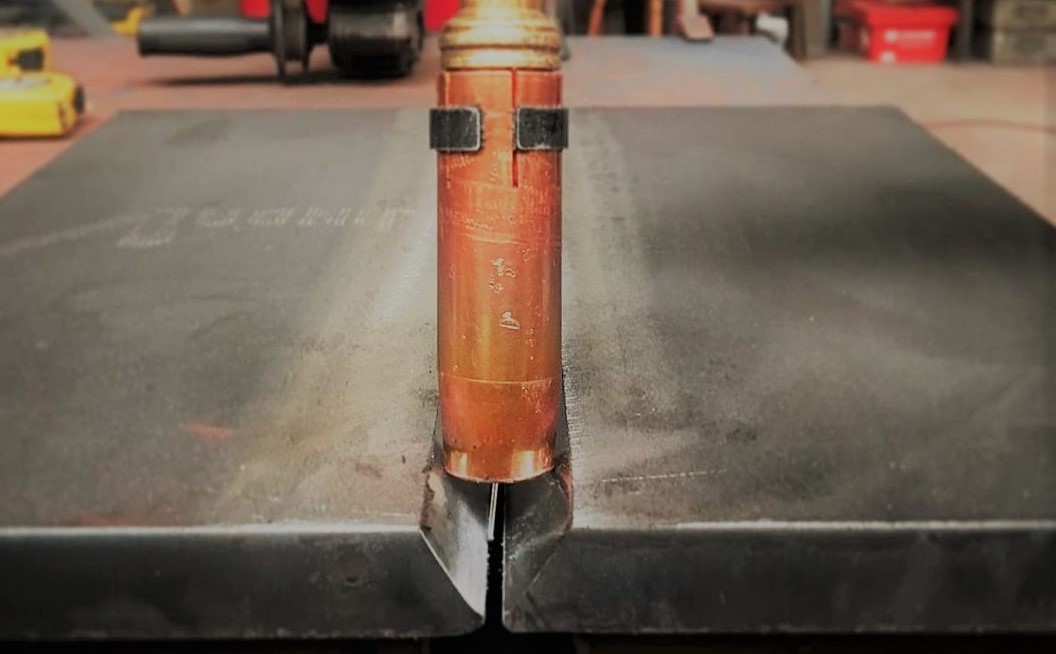
The terms Arc Voltage and Arc Length are often used interchangeably; the truth is that these terms are different even though they are effectively related. In the GMAW process, arc length is a critical variable that must be carefully controlled; for example, in spray transfer with argon shielding, an arc that is too short experiences momentary short circuits. These short circuits cause pressure fluctuations that pump air into the arc stream, causing porosity and loss of ductility due to absorbed nitrogen. If the arc is too long, it tends to wander, affecting both penetration and the weld face profile. A long arc can also disrupt the shielding gas. In the case of buried arcs with carbon dioxide shielding, a long arc generates excessive spatter as well as porosity; if the arc is too short, the electrode tip short-circuits with the weld pool causing instability. Arc length is the independent variable.
Arc voltage depends on arc length as well as many other variables such as the composition and dimensions of the electrode, the shielding gas, the welding technique, and since it is often measured at the power source, even the length of the welding cable. Arc voltage is an approximate means of measuring the physical arc length in electrical terms, although arc voltage also includes the voltage drop across the electrode extension protruding from the contact tip. If all variables are held constant, arc voltage is directly related to arc length. Although arc length is the variable of interest and the variable that should be controlled, voltage is easier to monitor. For this reason, and due to the normal requirement that arc voltage be specified in the welding procedure, it is the term most frequently used. Established arc voltage levels vary depending on the type of base material, shielding gas, and metal transfer mode. Trial-and-error testing is required in order to adjust the arc voltage to produce the most favorable arc characteristics and weld bead appearance. Such tests are essential because the optimum arc voltage depends on a variety of factors, including base material thickness, joint type, welding position, electrode size, shielding gas composition, and weld category (groove or fillet welds, for example). From a specific arc voltage value, an increase in voltage tends to flatten the weld bead and increases the width of the fusion zone.
Excessively high voltage can cause porosity, spatter, and undercut. A reduction in voltage results in a narrower weld bead with a higher crown and deeper penetration. Excessively low voltage can cause the electrode to stub.
TRAVEL SPEED.
Travel speed is the rate of linear movement of the arc along the joint to be welded. With all other conditions held constant, weld penetration is maximum at an intermediate travel speed. When travel speed is reduced, the deposition of filler metal per unit length increases. At very low speeds, the welding arc acts more on the weld pool than on the base metal, thereby reducing effective penetration; this condition also produces a wider weld bead. As travel speed increases, the amount of thermal energy per unit length of weld transferred from the arc to the base metal initially increases, since the arc acts more directly on the base metal. With a further increase in travel speed, less thermal energy per unit length of weld will be transferred to the base metal. Therefore, base metal fusion first increases and then decreases as travel speed is raised. If travel speed is increased still further, there will be a tendency to produce undercut along the edges of the weld bead due to insufficient filler metal deposition to fill the path melted by the arc.
Ask the DoctorWelding assistant about this topic and it answers citing our articles.

The answer is very simple: yes, it is possible. In fact, since the early development of the GMAW…
Stainless steels are a group of materials whose main characteristic is corrosion protection, due to their CHROMIUM content,…