WELDING PROCESS 
CAN ALUMINUM BE WELDED WITH THE MIG/MAG PROCESS?
The answer is very simple: yes, it is possible. In fact, since the early development of the GMAW…

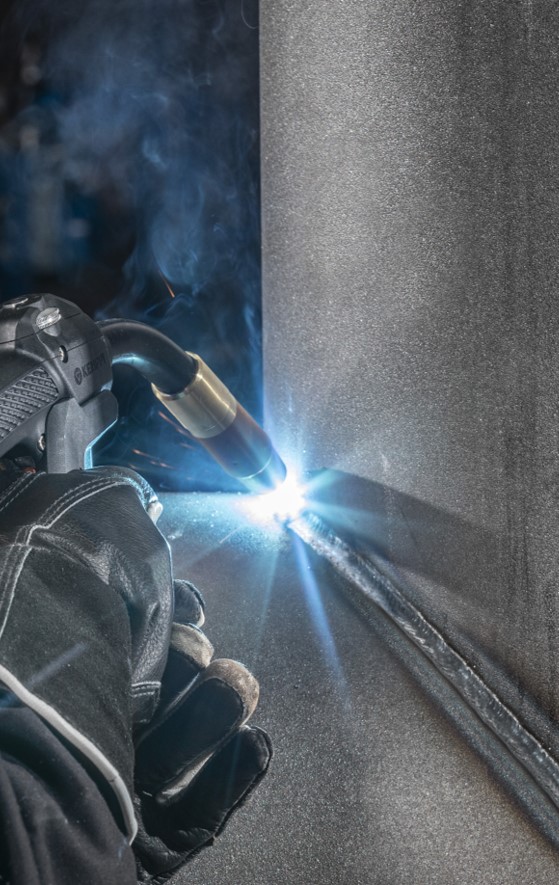
The shielding gas in GMAW welding is a vital element; it is the third member of the triangle that makes up the process: power source, filler material, and shielding gas. Although it is recognized that gas represents only a small percentage of the total production cost, its correct selection can produce significant savings due to increased productivity, quality, and reduced costs, by obtaining well-formed, defect-free weld beads.
Whenever stainless steel welding joints are made using the GMAW process, confusion arises regarding the type of gas to use, since it is thought that welding stainless steels requires 100% inert gases. This is not the case; shielding gases with a high proportion of inert gases are required, but they also need a small proportion of active gases to help stabilize the arc and the process transfer.
To use the GMAW process for welding genuine AISI 304 stainless steels on which weld beads are deposited, using a filler of type ER 308LSi, per AWS A5.9 specification, the following shielding gases can be used for this joint: Argon, Ar-O2, Ar-CO2, Ar-He-CO2, He-Ar-CO2, Ar-CO2-NO, Ar-NO, Ar-He-H2, Ar-He.
A wide variety of gas mixtures for welding stainless steels with the MIG-MAG process can be found, for example:
99% argon, 1% oxygen: improves arc stability, produces a more controllable weld pool, and minimizes undercutting.
90% helium, 7.5% argon, and 2.5% CO2: produces a smaller heat-affected zone, no undercutting, and minimal distortion.
98% argon, 2% oxygen: minimizes undercutting, provides good toughness, and less spatter.
What shielding gas flow rate should be set on the regulator in the MIG MAG process to ensure adequate shielding?
Gas flow regulation is a fundamental parameter, as it can significantly contribute to cost savings in the application of the process. The proper flow setting will depend on working conditions, since setting the gas output for welding in a shop where no drafts are present is not the same as working in field conditions where drafts do occur. Although the process is not recommended for outdoor work, it is important to check and set the appropriate shielding flow.
It should be kept in mind that the flowmeter is not an instrument that supplies gas pressure during welding operations; it simply maintains a constant flow that acts as a shield for the weld pool.
The most recommended gas flow values for MIG (inert gas) welding are:
Some causes that can generate porosity in the GMAW process
Ask the DoctorWelding assistant about this topic and it answers citing our articles.

The answer is very simple: yes, it is possible. In fact, since the early development of the GMAW…
Stainless steels are a group of materials whose main characteristic is corrosion protection, due to their CHROMIUM content,…