No Catergory 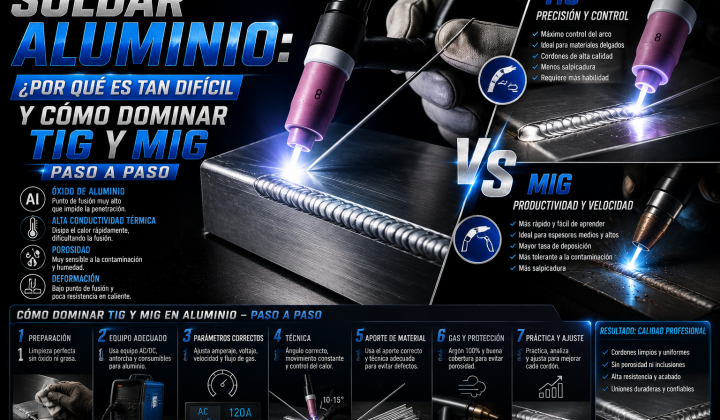
Welding Aluminum: Why It’s So Difficult and How to Master TIG and MIG Step by Step
Beginner's Guide to Aluminum Welding: Oxide Cleaning, Shielding Gas, Polarity, and Equipment Settings for TIG and MIG.

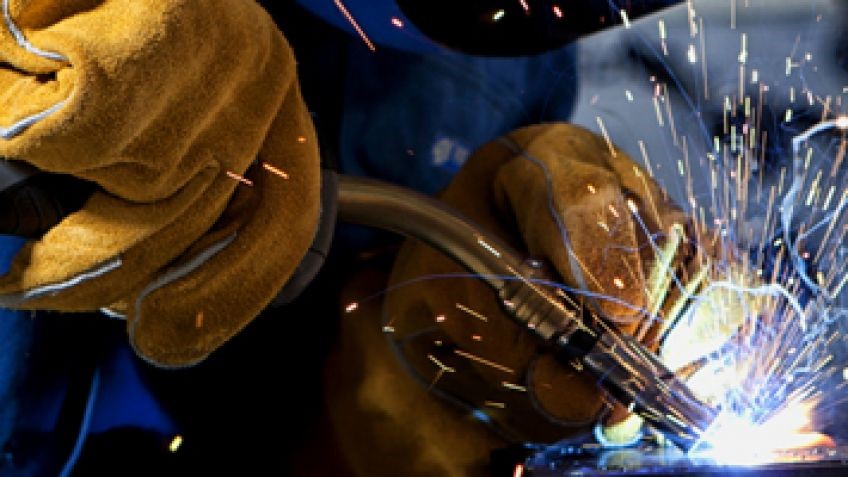
Hands are one of the most important parts of the human body; they belong to one of the five human senses (touch) and make it easier to carry out daily activities that would truly be complex or difficult to perform without them.
Hands extend from the wrist to the fingertips (thumb, index, middle, ring, and little finger), allowing objects to be gripped firmly and small parts to be manipulated with great precision. Movement commands are issued by the brain and controlled by the muscles located in the forearm; the hand is held together by simple ligaments and is so delicate that any modification to it disrupts the entire operational system.
Hands are exposed to constant hazards in specific operations (welding):
These can cause severe accidents such as: lacerations, burns, blisters, crushing injuries, abrasions, amputation, and psychological damage.
Workplace safety statistics indicate that 35% of occupational accidents in welding are related to the hands, and their outcomes are severe, irreparable consequences.
What gloves should be used for welding protection?
Welding gloves are a mandatory personal protective equipment (PPE) item that protects personnel performing welding operations by minimizing and preventing the hazards mentioned above. The key features of welding gloves are protection against spatter, short-term exposure to an open flame or a hot workpiece, heat from fluids (molten metal droplets), and invisible ultraviolet and infrared radiation — in any welding process (SMAW, GMAW MIG-MAG, FCAW, GTAW, PAC) — as well as mechanical hazards such as impacts and cuts.
Gloves that are properly selected must meet manufacturing properties established by certain standards:
MECHANICAL STANDARD UNE EN 388, THERMAL STANDARD UNE EN 407.
Below are some examples of characteristics set forth by these standards, which indicate that the scales mentioned are rated across six levels; meaning that the higher the level, the greater the resistance in both the mechanical and thermal tests.
Ask the DoctorWelding assistant about this topic and it answers citing our articles.

Beginner's Guide to Aluminum Welding: Oxide Cleaning, Shielding Gas, Polarity, and Equipment Settings for TIG and MIG.
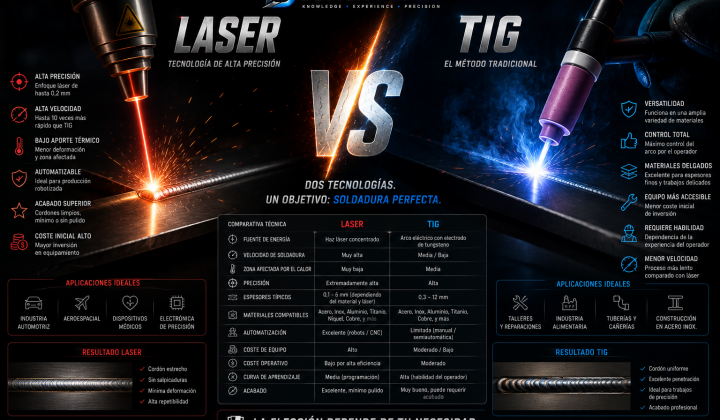
Comparison between laser and TIG welding focusing on the advantages of laser: speed, distortion, penetration, and automation.