No Catergory 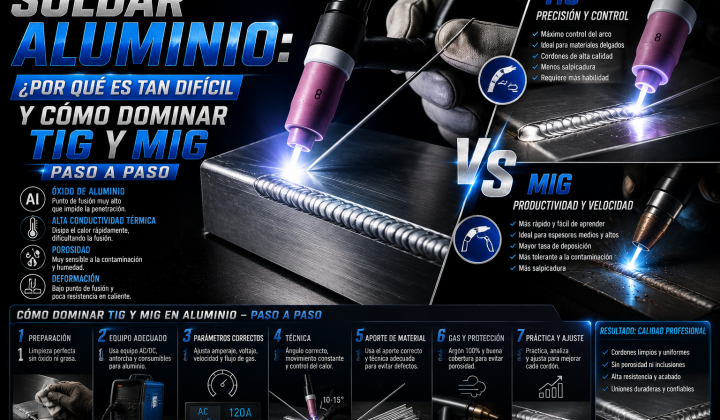
Welding Aluminum: Why It’s So Difficult and How to Master TIG and MIG Step by Step
Beginner's Guide to Aluminum Welding: Oxide Cleaning, Shielding Gas, Polarity, and Equipment Settings for TIG and MIG.

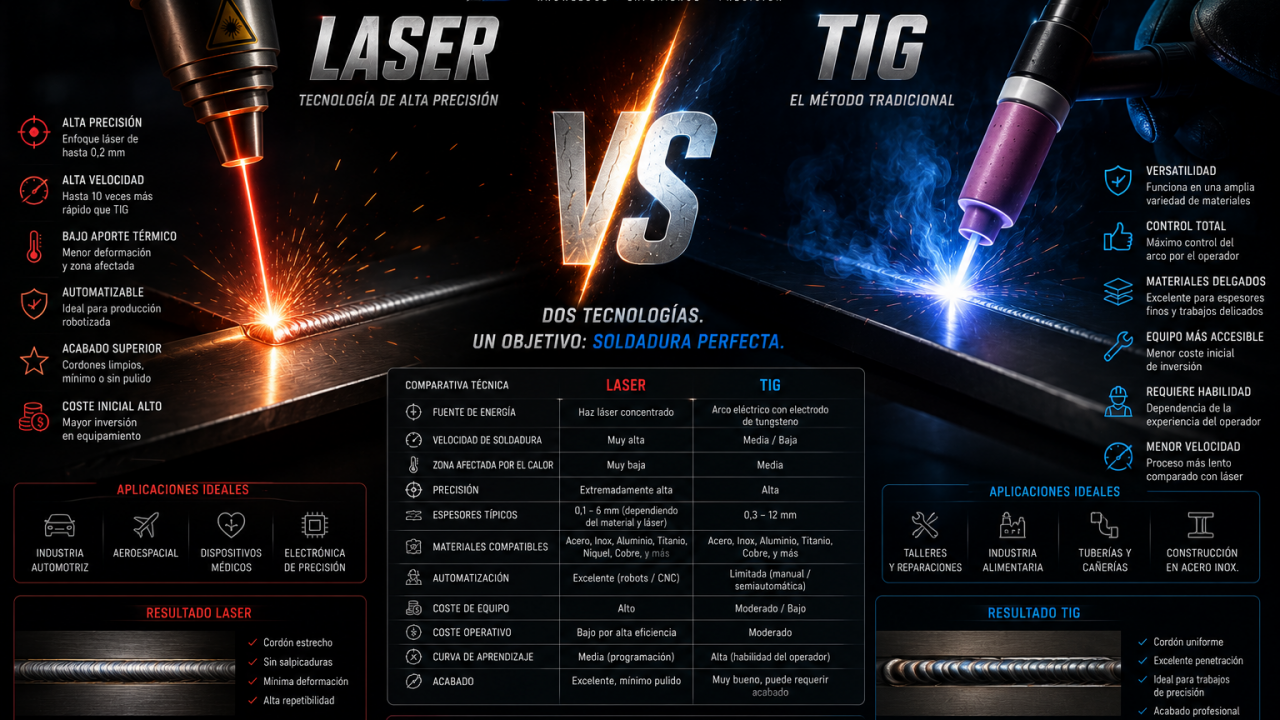
TIG welding (GTAW) has been the gold standard for high-quality joints in stainless steel, aluminum, and special alloys for decades. However, the rise of laser welding equipment—especially handheld fiber laser systems—is changing the rules of the game in many workshops.
In this article, we analyze the main advantages of laser welding compared to TIG.
The strongest argument for laser welding is productivity. The extremely high energy density of the laser beam allows welding at travel speeds that, according to manufacturers, can be three to six times faster than an equivalent TIG process on thin sheet metal.
This means less welding time per part and higher production output per shift.
Laser welding concentrates heat in a very small area, which significantly reduces the heat-affected zone (HAZ).
The practical advantages include:
Thanks to the keyhole welding effect, laser welding can produce narrow weld beads with a high depth-to-width ratio—something that is difficult to achieve with TIG without multiple passes.
This makes single-pass butt joints possible in thicknesses that would often require edge preparation or multiple passes with TIG.
New handheld laser welding systems can reduce the learning curve compared to TIG, which requires very precise coordination between the torch, filler rod, and weld pool.
That said, final weld quality still depends on proper joint preparation, correct parameter settings, and operator skill.
In many thin-sheet applications, laser welding can be performed by direct fusion, with no filler material or only minimal filler. This can reduce consumable costs compared to TIG welding.
| Parameter | Fiber Laser Welding | TIG Welding (GTAW) |
|---|---|---|
| Welding speed | High | Medium to low |
| Heat input / HAZ | Very low | Moderate |
| Distortion | Low | Medium |
| Typical thickness range | Up to 10 mm | Over 10 mm |
| Learning curve | Shorter with handheld systems | Longer |
| Initial investment | High | Low to medium |
| Shielding gas | Argon / nitrogen | Argon |
Although this article focuses on the advantages of laser welding, it is important to remember that TIG remains the preferred process in certain scenarios.
TIG still offers excellent control for very thick parts, complex welding positions, precision repair work, and applications where the investment in laser welding equipment is not justified.
Laser welding is especially strong in serial production, thin and medium sheet metal applications, and workshops looking to increase productivity while reducing distortion and post-weld finishing.
Laser welding offers clear advantages in speed, thermal control, and productivity, making it a highly attractive alternative to TIG in many workshops.
However, the final decision should be based on the type of part, material thickness, production volume, quality requirements, and return on investment. These factors should be evaluated case by case.
Laser welding involves specific risks, including Class 4 laser radiation, eye and skin hazards, metal fumes, and potential reflections.
Certified eye protection for the specific wavelength of the equipment is mandatory. The work area must be properly controlled and separated, and effective fume extraction should be used.
Always follow the manufacturer’s instructions and all applicable local safety regulations.
Ask the DoctorWelding assistant about this topic and it answers citing our articles.

Beginner's Guide to Aluminum Welding: Oxide Cleaning, Shielding Gas, Polarity, and Equipment Settings for TIG and MIG.
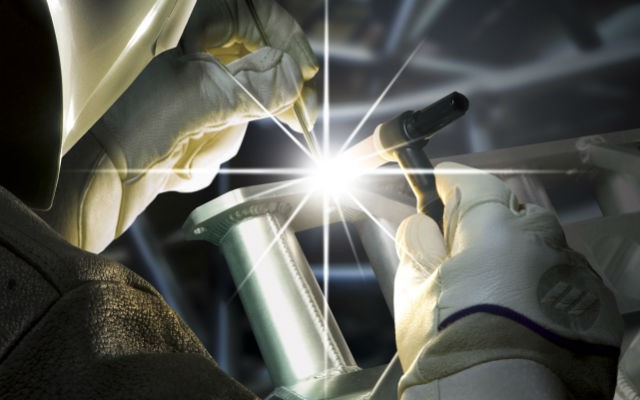
Tungsten inclusions are almost always associated with the GTAW process, which uses a tungsten electrode to establish the…