No Catergory 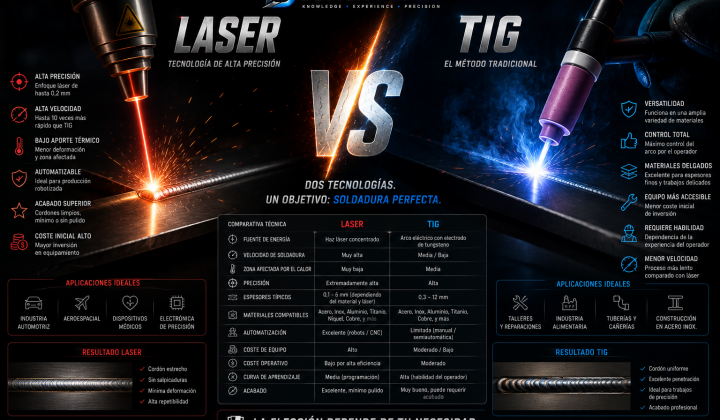
Laser Welding vs. TIG: Why More Workshops Are Making the Switch
Comparison between laser and TIG welding focusing on the advantages of laser: speed, distortion, penetration, and automation.
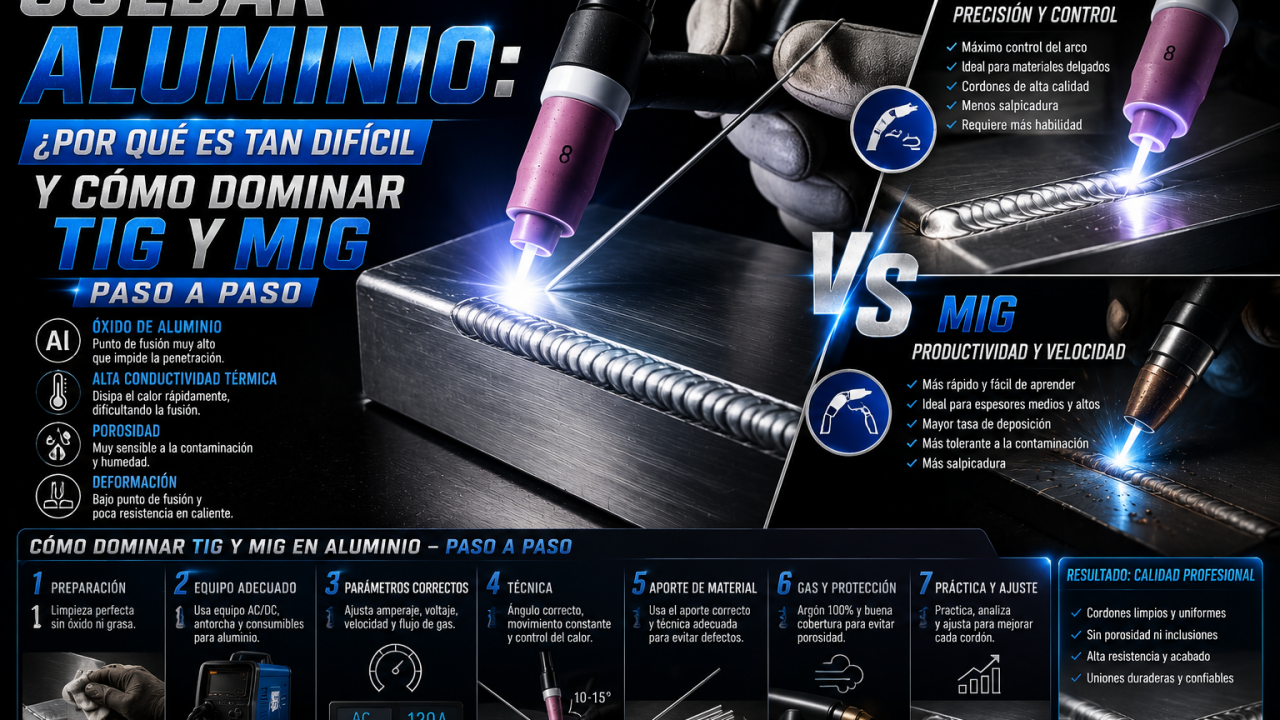
Aluminum has a reputation for being one of the most frustrating metals for anyone starting out in welding. It’s not that it’s impossible—it belongs to a different behavioral category compared to steel, and many of the tricks that work with carbon steel actually work against you here. In this draft we review why it’s so difficult and how to tackle it with TIG and MIG from scratch.
There are three physical characteristics of aluminum that explain almost all of the beginner’s problems:
Added to this is the sensitivity to porosity (hydrogen dissolves easily in the weld pool) and the tendency to “burn through” thin sheet.
If you take only one idea away from this article, let it be this: without proper cleaning there is no decent aluminum weld. The usual process has two phases:
Practical recommendations:
Here lies one of the major differences from steel.
Aluminum is almost always welded with inert gas, not active mixtures like those used for steel:
| Parameter | TIG (AC) | MIG (DCEP) |
|---|---|---|
| Gas | Pure argon | Pure argon |
| Polarity | AC + HF | DCEP |
| Initial amperage (≈2–3 mm) | ~80–120 A (rule of thumb ≈40 A/mm) | ~100–130 A |
| Gas flow rate | 10–12 L/min | 14–18 L/min |
| Filler/wire diameter | 1.6–2.4 mm (filler ER4043/ER5356) | 0.8–1.0 mm (wire ER4043/ER5356) |
| AC balance | ~30 % cleaning (≈65–70 % EN) | N/A |
Note: all specific values must be adjusted to the actual machine, thickness and alloy. Treat them as a starting point for testing, not as a fixed recipe.
Aluminum isn’t harder, it’s different. Master cleaning and correct polarity first and you’ll have solved half the problem; the rest is practice on scrap sheet until you learn to “read” the weld pool. This draft should be validated with real parameters before publishing.
Safety: Work with adequate ventilation or extraction: aluminum welding fumes and the ozone generated by the arc can be harmful. Use a helmet with an appropriate filter shade, gloves, flame-resistant clothing and respiratory protection if necessary. Handle compressed gases and solvents (acetone) according to their safety data sheets and away from ignition sources.
Ask the DoctorWelding assistant about this topic and it answers citing our articles.

Comparison between laser and TIG welding focusing on the advantages of laser: speed, distortion, penetration, and automation.
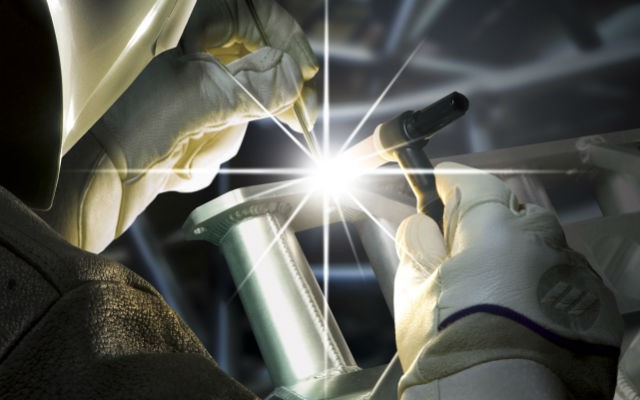
Tungsten inclusions are almost always associated with the GTAW process, which uses a tungsten electrode to establish the…