QUALITY 
WHAT IS UNDERCUT? A DEFECT OR DISCONTINUITY.
Undercut is a surface discontinuity that occurs in the base metal directly adjacent to the weld bead; depending…
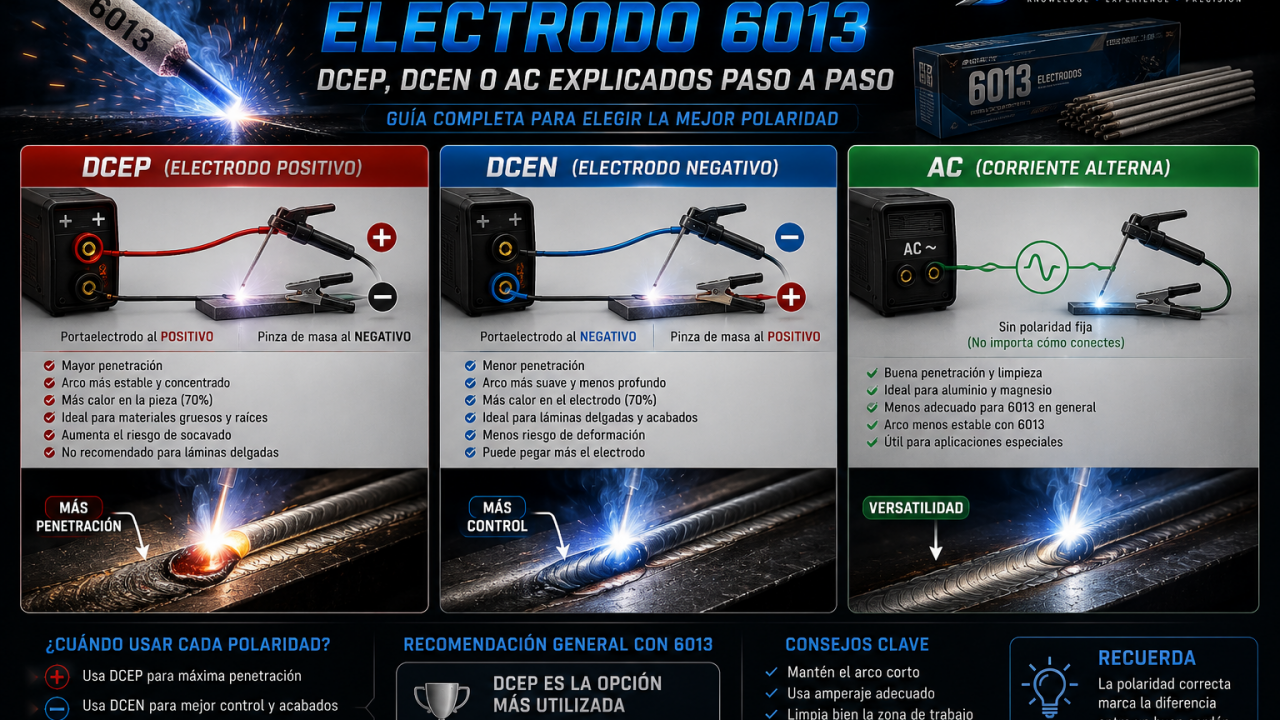
The 6013 electrode is one of the most popular among beginners and hobbyists for a very specific reason: it is a forgiving electrode with a soft arc that is easy to maintain. Part of that versatility comes from its ability to run on all three polarities available on an arc welding machine: direct current electrode positive (DCEP), direct current electrode negative (DCEN), and alternating current (AC). But “can” does not mean “it doesn’t matter”: each polarity changes the penetration, the deposition, and the arc behavior. In this guide we explain step by step how to choose the right one according to your machine, the working position, and the result you are after.
In direct current, the welding circuit has a fixed direction and we can decide which terminal we connect the electrode holder to. In that flow of electrons, roughly two thirds of the heat is concentrated at the positive pole and one third at the negative one. This distribution is the key to understanding everything else.
The 6013 has a coating rich in rutile (titanium dioxide), which ionizes the air easily and keeps the arc lit even when the current passes through zero fifty or sixty times per second, as happens in AC. That is why, unlike electrodes that only work on direct current, the 6013 can weld on AC without any problem. Its designation (according to the AWS A5.1 system) ends in “3,” which precisely indicates compatibility with AC, DCEP, and DCEN.
Step 1: Check what current your machine delivers. If your machine is AC only (some domestic transformers are), your decision is already made: you will weld on AC and the 6013 will do it perfectly. If you have an inverter or rectifier with DC output, you will have to choose between DCEP and DCEN.
Step 2: Assess the thickness and type of sheet. For thin sheet, where the risk of burning through is high, DCEN reduces penetration and gives a flatter, more controlled bead. On heavier materials or when you want somewhat deeper fusion and a very stable arc, DCEP is the more balanced option.
Step 3: Think about the position. In flat and horizontal, any polarity behaves well. For vertical and overhead, a more stable arc and a slightly less fluid weld pool help to control gravity; many welders prefer DCEP in these positions for the firmness of the arc.
Step 4: Check whether arc blow appears. If the arc persistently deflects to one side (typical on large magnetized parts or with the ground clamp poorly placed), switching to AC usually eliminates that blow, because the constant reversal of polarity neutralizes the magnetic effect.
Step 5: Test and adjust. Run a test bead on an offcut of the same material. Observe the striking, the stability, the appearance of the bead, and how easily the slag comes off. If everything goes well, keep that setup.
The amperage values depend mostly on the diameter of the electrode and the thickness of the workpiece. These are typical ranges from standard practice; adjust them according to your consumable manufacturer and your prior test.
| Electrode diameter | Typical amperage (A) | Recommended sheet thickness | Common polarity |
|---|---|---|---|
| 1.6 mm | 25 – 55 | Very thin sheet | DCEN / AC |
| 2.0 mm | 40 – 75 | Thin | DCEN / DCEP / AC |
| 2.5 mm | 60 – 100 | Medium-thin | Any |
| 3.2 mm | 90 – 140 | Medium | DCEP / AC |
| 4.0 mm | 130 – 190 | Thick | DCEP / AC |
As a quick starting rule, many welders figure around 30 to 40 amps per millimeter of electrode diameter, and then fine-tune according to the result.
The 6013 is a generous electrode: it lets you work on DCEP, DCEN, or AC and responds well on all of them. The right choice depends on three factors you now know how to assess: the type of current your machine delivers, the thickness and position of the workpiece, and the finish you are after. Use DCEN for thin sheet and maximum deposition, DCEP for a stable arc and balanced penetration, and AC when your machine requires it or when arc blow complicates your life. With a test bead and a small amperage adjustment, you will have full control over your weld.
Safety: Always work with the machine switched off when changing the polarity connections at the terminals. Use a welding helmet with a suitable filter, gloves, and flame-resistant clothing, and weld in ventilated areas to avoid inhaling fumes. Check the insulation of leads and electrode holders before each use.
Ask the DoctorWelding assistant about this topic and it answers citing our articles.

Undercut is a surface discontinuity that occurs in the base metal directly adjacent to the weld bead; depending…
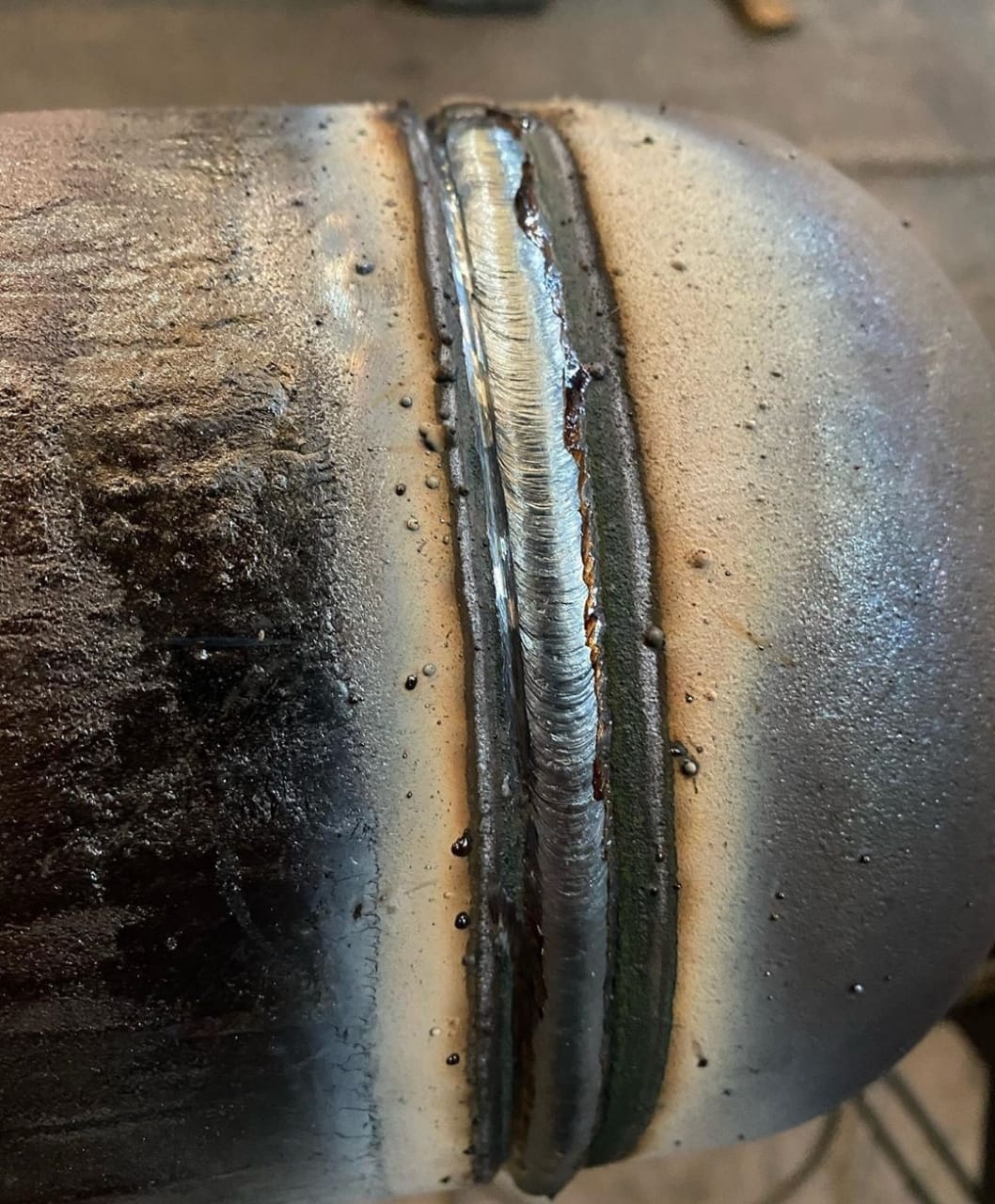
Spatter is a defect that occurs in welding processes where metal transfer takes place through an electric arc.…