QUALITY 
WHAT IS UNDERCUT? A DEFECT OR DISCONTINUITY.
Undercut is a surface discontinuity that occurs in the base metal directly adjacent to the weld bead; depending…

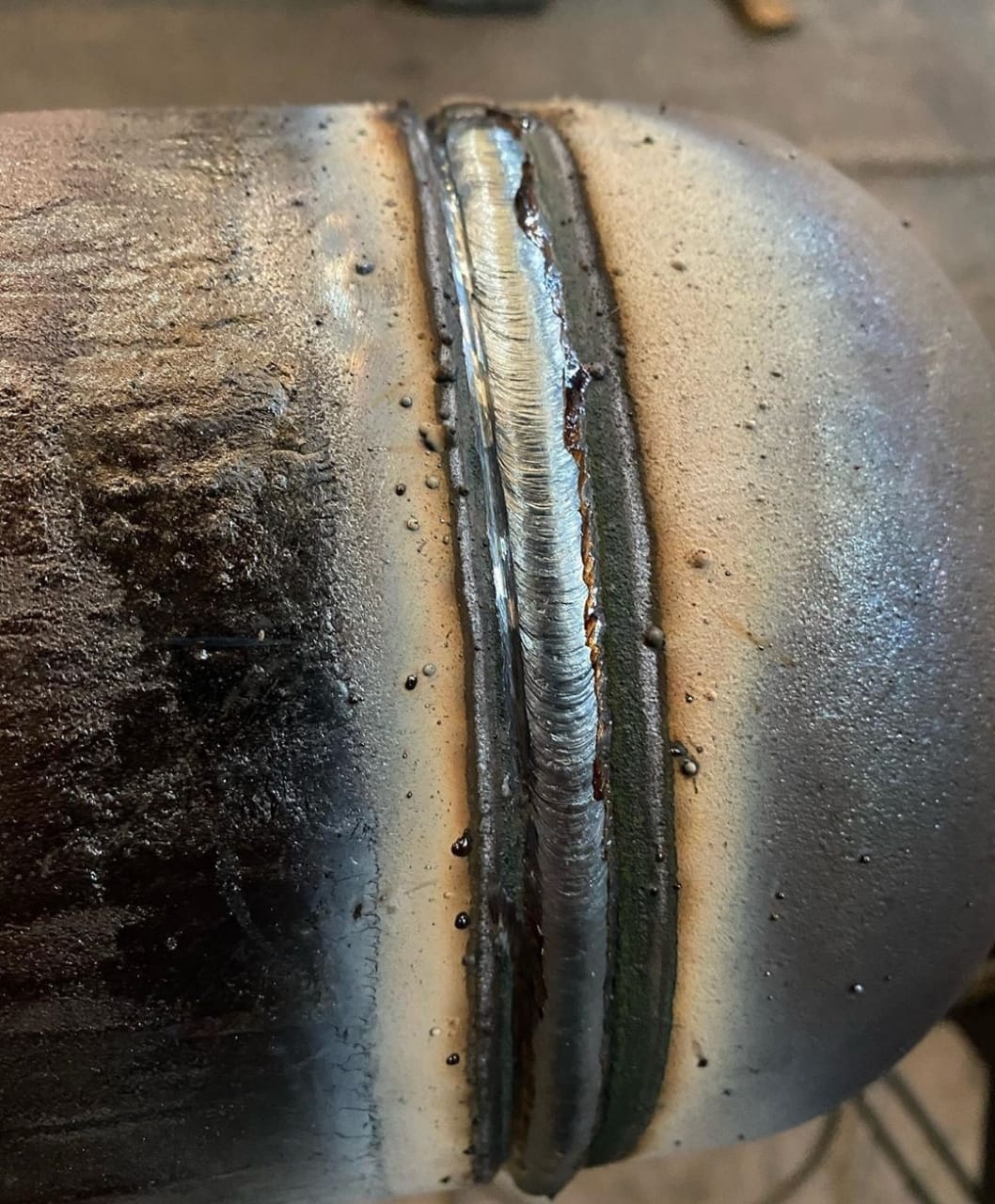
Spatter is a defect that occurs in welding processes where metal transfer takes place through an electric arc. Processes such as SMAW, GMAW, and FCAW are the most prone to generating this defect, especially when the equipment parameters are not properly set.
According to the American Welding Society standard AWS A 3.0, spatter is described as metal particles expelled during fusion that do not form part of the weld. They are commonly understood as particles adhered to the base metal adjacent to the weld. However, particles thrown beyond the weld and the base metal also constitute spatter; for this reason, another definition may be the difference between the amount of metal melted and the amount of metal deposited in the joint.
Spatter is not a critical defect. When the particles are very large, they can create a localized HAZ (Heat-Affected Zone) on the surface of the base metal, with an effect similar to that of an arc strike. An example of this situation is shown in the figure, in which a spatter globule has become embedded in the base metal. The presence of this stress concentrator in a corrosive environment can also serve as a stress concentration point capable of triggering an energy release in a tank. It is always advisable to remove this type of defect from the weld joint.
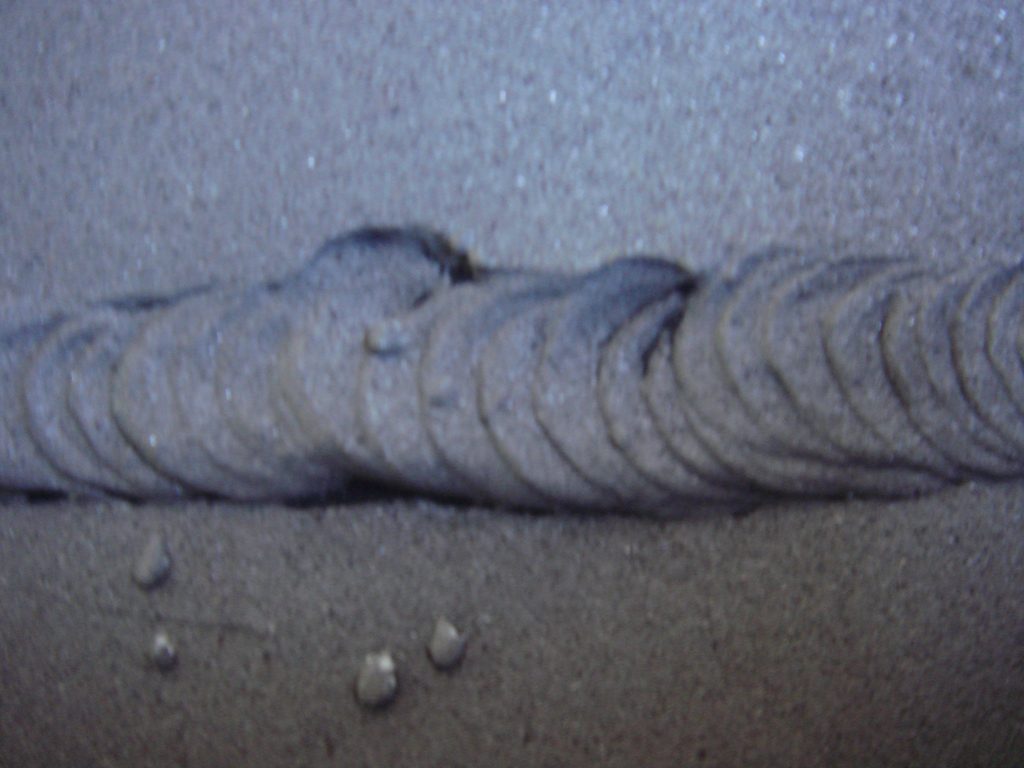
When spatter is present, it also damages the appearance of the weld. Another drawback relates to the irregularities produced on the surface. During weld inspection using nondestructive testing methods, the presence of spatter can produce indications that generally mask the true weld defects.
For example, in ultrasonic testing the transducer cannot be properly coupled, and interpretation problems may also arise in magnetic particle testing and liquid penetrant testing.
Spatter can result from the use of high amperage levels, which cause excessive turbulence in the weld zone. Some processes generate greater amounts of spatter than others; for example, the use of globular or short-circuit transfer in the GMAW process tends to produce higher spatter levels than spray transfer. Using argon and CO2 shielding gas mixtures produces less spatter than CO2 alone, as does welding with low inductance.
Another process that generates considerable spatter is FCAW; when voltage and amperage parameters are not balanced, an unstable transfer is established, producing large amounts of spatter. It is advisable to ensure that the parameters are properly set to achieve a stable transfer. In the SMAW or MMA process, it is important to verify the correct amperage to minimize spatter generation and to check proper electrode storage. Welding technique also plays an important role in spatter generation in the weld bead.
Ask the DoctorWelding assistant about this topic and it answers citing our articles.

Undercut is a surface discontinuity that occurs in the base metal directly adjacent to the weld bead; depending…
Symbology is a very important communication channel between the design department and the manufacturing department, which is why…