No Catergory 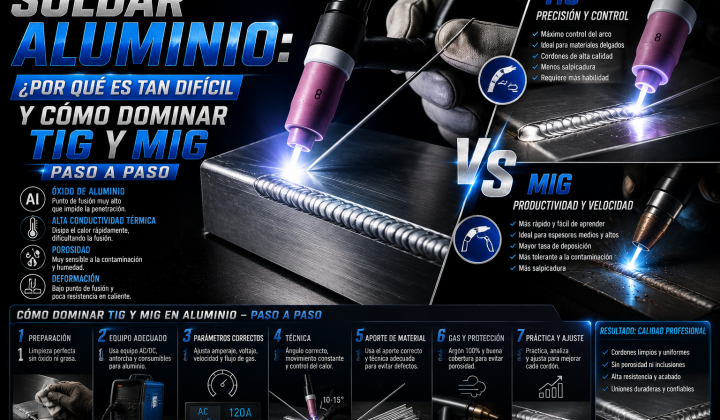
Welding Aluminum: Why It’s So Difficult and How to Master TIG and MIG Step by Step
Beginner's Guide to Aluminum Welding: Oxide Cleaning, Shielding Gas, Polarity, and Equipment Settings for TIG and MIG.
Metal joining has a long history, as it has always accompanied the development of civilizations, and although for many it may seem commonplace, this science has undergone many years of development and updates. At Doctor Welding, we will open a space to discuss welding equipment, brands, their development, and all the people who have contributed their part to bring us the technology we have today.
It is very difficult to determine exactly who was the first to develop something resembling electric welding, as experiments were taking place simultaneously in different countries. The earliest experiments date back to the beginning of the 19th century, although welding as we know it today began to take shape at the start of the 20th century. Below are the first scientists and experts in the development of welding equipment.
Elmer Humphry Davy. He was a British chemist who, at the beginning of the year 1800, began experimenting with electrolysis and the possibilities of the electric arc he had just discovered. As a result, between 1806 and 1808, he achieved the isolation of elements such as magnesium, strontium, calcium, barium, sodium, chlorine, boron, and potassium.
Davy is considered the founder of electrochemistry alongside more renowned scientists such as Alessandro Volta and Michael Faraday.
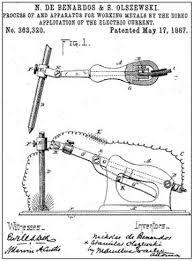
Experiments with the electric arc continued for a few decades until 1885, when Nikolay Benardos and Stanisław Olszewski patented the first welding equipment, consisting of a metal anode and a carbon cathode. That same year and over the following 15 years, Elihu Thomson refined several resistance welding systems, and in 1892 Nikolay Slavyanov created the first consumable electrode.
Other fundamental contributions were those of ZERENER. At that time, the welding work performed was not sufficiently efficient, as it was very difficult to control the electric arc, due to the fact that it was generated irregularly. Continuing with the trials and in search of better results, a conclusive success was achieved by reversing the polarity of the electrodes (connecting the workpiece to the positive terminal), because under these conditions the arc was not generated from any random point on the carbon electrode, but only from the tip, that is, in the same plane as the joint.
The behavior of the arc, depending on the chosen polarity, led in 1889 to the German physicist, Dr. H. Zerener, to test a type of welding by generating an electric arc between two carbon electrodes. Since under these conditions good arc stability could not be achieved, he added an electromagnet, which acted upon the arc, directing it magnetically in the desired direction. This produced a blow effect on the electric arc. For this reason, this type of welding was called blown arc welding, finding interesting applications in automatic processes for thin sheet metal. The arc flow was easily regulated by varying the excitation current of the electromagnet, as well as varying the magnetic field produced.
The resulting electric arc was highly stable. The two carbon electrodes and the electromagnet were part of a single portable assembly. The filler metal came from a third metal rod, which was positioned below the arc, closer to the workpiece. With the heat produced, the base metal melted together with the filler rod, generating the joint.
This system was used industrially for the first time in 1899 by the firm Lloyd & Lloyd of Birmingham (England), to weld 305 mm diameter iron pipes, which after being welded were capable of withstanding a hydraulic test of 56 atmospheres. The work was carried out using 3 dynamos of 550 amperes each at a potential of 150 volts, which charged a battery of 1,800 accumulators, intended to supply a heavy current over a brief period of time. In the United States, in 1902, the first factory to begin using carbon electrode arc welding industrially was The Baldwin Locomotive Works.
Ask the DoctorWelding assistant about this topic and it answers citing our articles.

Beginner's Guide to Aluminum Welding: Oxide Cleaning, Shielding Gas, Polarity, and Equipment Settings for TIG and MIG.
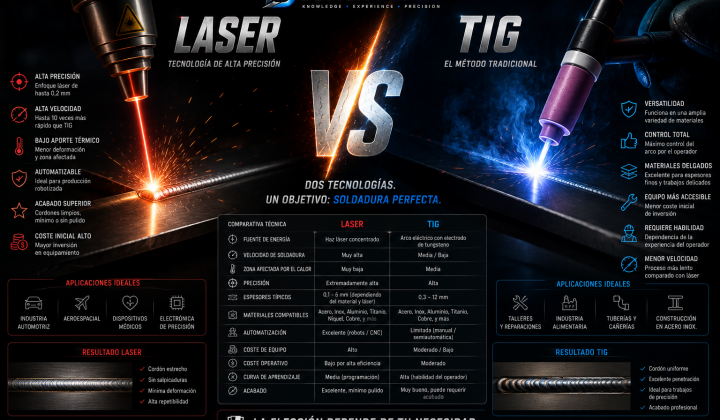
Comparison between laser and TIG welding focusing on the advantages of laser: speed, distortion, penetration, and automation.