No Catergory 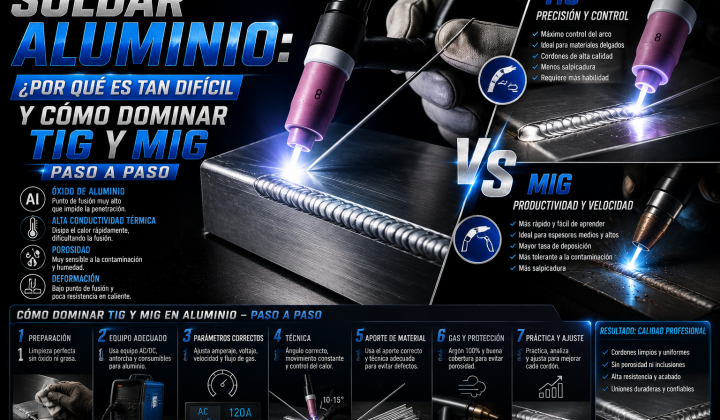
Welding Aluminum: Why It’s So Difficult and How to Master TIG and MIG Step by Step
Beginner's Guide to Aluminum Welding: Oxide Cleaning, Shielding Gas, Polarity, and Equipment Settings for TIG and MIG.

In the industry in general, different types of applications related to welding can be found; protective coatings are a specialized area where many factors must be analyzed to achieve the best results.
This type of application generates significant savings by increasing the service life of parts that will be subjected to some form of wear. The following article will analyze the application of tungsten carbides; this type of carbide belongs to the group of the hardest and most resistant coatings. When applied as a weld overlay, it is a fast, easy-to-apply method with unmatched versatility and flexibility.
Tungsten carbide is an ideal material for severe abrasion applications, and different products exist to ensure success. Tungsten carbide hard overlay reduces wear on parts used in mining and ore processing, minerals, agricultural tools, construction and mining ground, and also has extensive application in the oil and gas drilling sector, as well as in tooling for tunnel boring and horizontal directional drilling — meaning its field of use is very broad.
What is the most commonly used welding process for applying tungsten carbides?
The following welding processes are listed in order of popularity of use:
A wide range of equipment and power sources is available on the market. The current trend is toward the use of semi-automatic and automatic welding processes using FCAW or GMAW, which share similar popularity. The GMAW process, whether using solid wire or metal-cored wire, must always be used with gas shielding; whereas the FCAW process employs some wires that do not require gas shielding and others that do. The shielded metal arc welding process, SMAW, continues to be very popular, especially for field applications due to the versatility and portability of the required equipment.
The following are some factors to be considered for proper welding process selection:
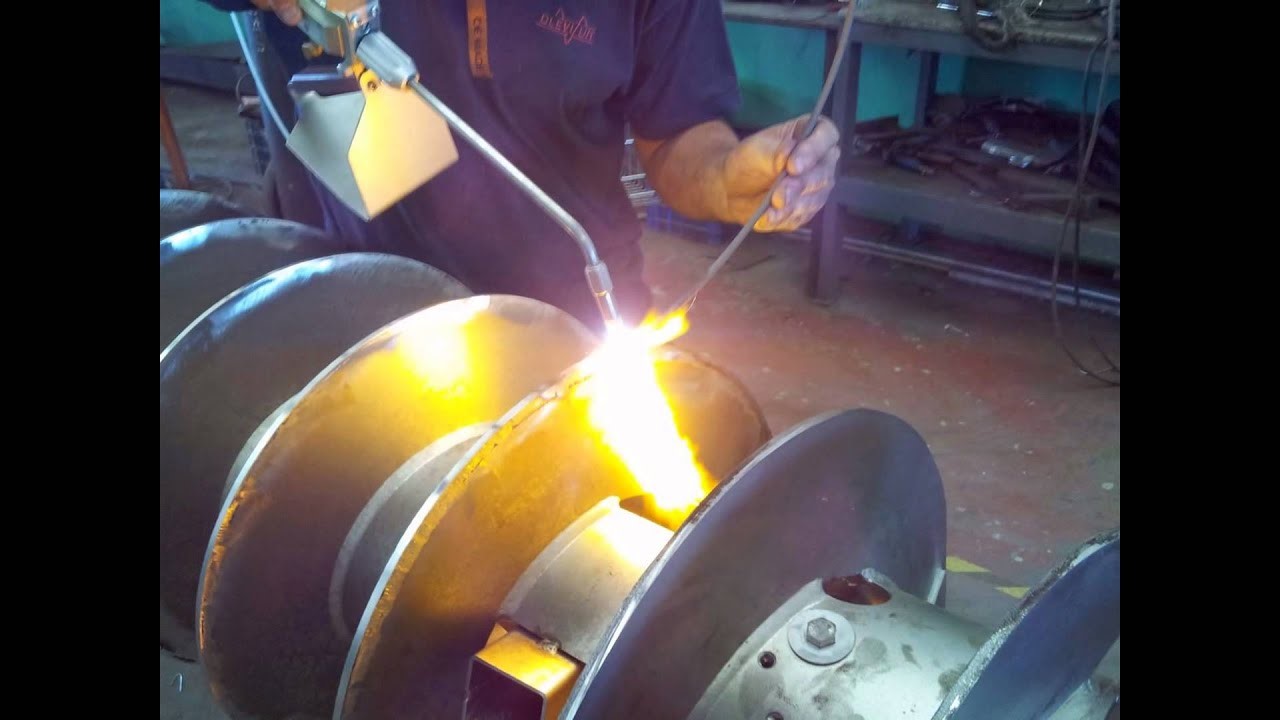
For the proper application of tungsten carbides, the welding process must be carefully analyzed and selected. In many locations, chemical combustion processes such as oxyfuel are still used; if this is the chosen application, an oxidizing flame must be established using a tip size number 5 or larger, depending on the application to be performed. For this application, apply uniform heating to the workpiece, use the filler material with flux, and always maintain the heat on the workpiece and the weld until fusion is achieved. With this type of application, hardness values of up to 70 HRC can be attained. After applying the weld, control the cooling rate, as cracks and spalling of the coating may occur.
Ask the DoctorWelding assistant about this topic and it answers citing our articles.

Beginner's Guide to Aluminum Welding: Oxide Cleaning, Shielding Gas, Polarity, and Equipment Settings for TIG and MIG.
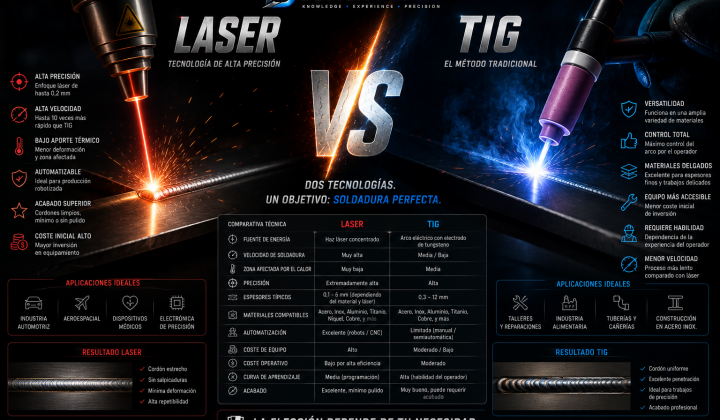
Comparison between laser and TIG welding focusing on the advantages of laser: speed, distortion, penetration, and automation.