No Catergory 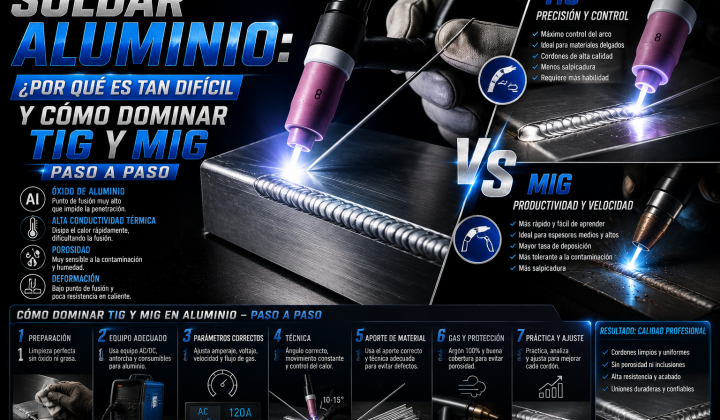
Welding Aluminum: Why It’s So Difficult and How to Master TIG and MIG Step by Step
Beginner's Guide to Aluminum Welding: Oxide Cleaning, Shielding Gas, Polarity, and Equipment Settings for TIG and MIG.

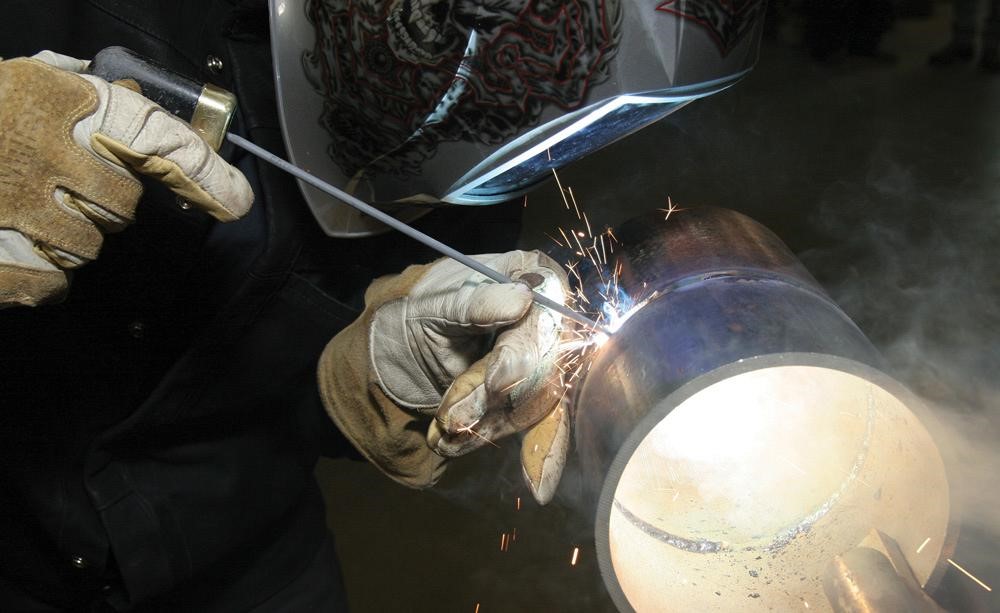
1.- Identify the base metal. Remember that welding is the surgery of metal, therefore, you must know the patient very well — in this case, the patient is the base material. When welding, you must always be certain of the type of material to be welded. If this information is not available, approximate it through spark tests, chip tests, etc., or perform a chemical analysis test to be certain of what material it is.
2.- Know the type of current available for welding, that is, whether direct current or alternating current is available. At this point, it is important to analyze the equipment to be used. In the previous article, we discussed the classification of welding equipment; however, what must be considered is that with the alternating current supplied by some equipment, the electric arc process will produce considerable spatter and arc instability. The ideal is to work with direct current at positive polarity in the vast majority of cases.
3.- Know the position in which the weld must be performed. The welding position plays a very important role in the application of high-quality welding. Based on this variable, the working parameters and the technique to be used are established.
4.- Know the thickness and shape of the base metal. This variable is important to know, as the parameters and electrode oscillation technique are adjusted according to the thickness.
5.- Know the joint design. Like the other variables, this one is very important, as it establishes the types of electrodes to be used, operating characteristics, technique, amperage range, strength, and structural design of the welded joint.
6.- Know the service specifications required for the joint. This factor requires analyzing the scope of the structure or component to be welded. This variable is highly relevant, as it determines the code or standard to be applied. Keep in mind that AWS has many codes and standards focused on the fabrication of metal structures. ASME has a code with 12 Sections focused on boilers and pressure vessels, and also includes additional codes and standards all centered on pressure vessels. The American Petroleum Institute (API) also works on providing standards and specifications for everything related to the transportation and storage of petroleum and gas products. These are the 3 main bodies, but there are many more that reference these 3 important institutions; in Europe, this system will certainly have other variations.
7.- Achieve efficiency and speed in the operation. Productivity is a competitive variable; therefore, speed and efficiency play a fundamental role. The use of higher-efficiency electrodes makes a differentiating impact in the manufacturing of metal products worldwide.
Although the different types of electrodes for various applications have different operating characteristics, there are some general implicit rules that apply without exception to all types of covered electrodes.
ELECTRODES ARE AVAILABLE FOR WELDING:
Ask the DoctorWelding assistant about this topic and it answers citing our articles.

Beginner's Guide to Aluminum Welding: Oxide Cleaning, Shielding Gas, Polarity, and Equipment Settings for TIG and MIG.
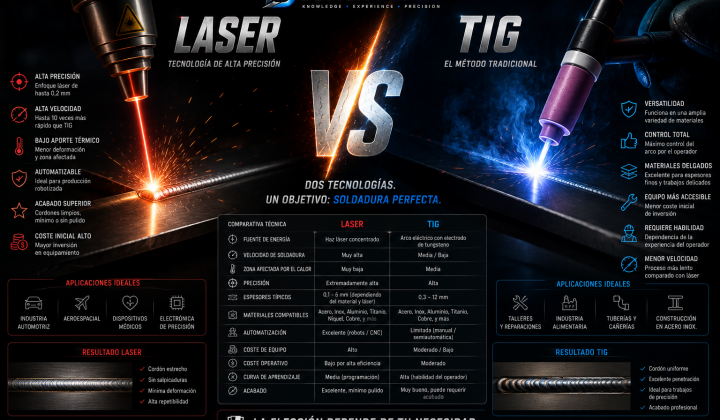
Comparison between laser and TIG welding focusing on the advantages of laser: speed, distortion, penetration, and automation.