No Catergory 
Welding Aluminum: Why It’s So Difficult and How to Master TIG and MIG Step by Step
Beginner's Guide to Aluminum Welding: Oxide Cleaning, Shielding Gas, Polarity, and Equipment Settings for TIG and MIG.

One factor that controls the microstructure of the heat-affected zone (HAZ) and the weld metal is the cooling rate; this rate depends on the base material thickness, joint geometry, heat input, and preheat temperature. The cooling rate can therefore be used, within a certain range, to prevent the formation of harmful microstructures in the HAZ and in the weld.
As a result of the cooling rate, hard metallurgical structures can develop in steel, and in extreme cases, cause a direct transformation from austenite to martensite.
If the material is heated prior to welding, the thermal gradient from the steel’s melting temperature is reduced, shifting the cooling curve to the right of the Temperature-Time-Transformation (TTT) diagram. This promotes metallurgical transformations to softer structures that are less brittle and less susceptible to cold cracking.
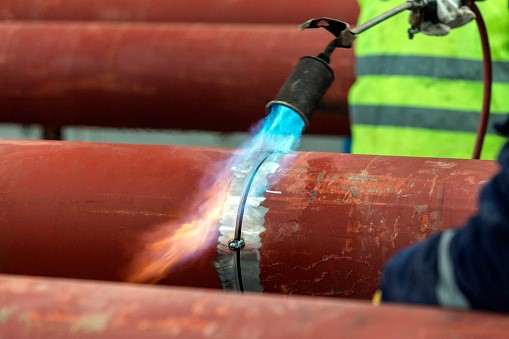
The primary function of the preheat temperature is to reduce the cooling rate of the welded assembly. It is the minimum temperature that must be achieved throughout the entire thickness and over a sufficiently wide zone on both sides of the joint in the base material before the welding process begins, and which must normally be maintained between passes in the case of multipass welding. It is applied locally by electrical resistance or gas flame, and its measurement is carried out, whenever possible, on the face opposite to the one where the heat source is being applied, by means of thermocouples or temperature-indicating sticks (thermal crayons).
The preheat temperature must be balanced with the heat input during the welding operation, according to the type of steel and based on the required properties of the joint.
The preheat temperature also produces an important effect on the hydrogen diffusion rate, achieves microstructures with lower hardness values in the HAZ and in the weld metal, and prevents martensite formation in high-carbon steels. In addition, it has the secondary effect of reducing residual stresses by decreasing the thermal gradients associated with welding.
Preheat includes the interpass temperature when dealing with multipass welding and when the heat generated during welding is not sufficient to maintain the preheat temperature between successive passes. In general, the preheat temperature required for multipass welding is lower than for single-pass welding. In multipass welding, the heat from the second pass reduces the hardness of the HAZ generated by the first pass and accelerates hydrogen migration. This significantly reduces the possibility of cold cracking in welded steels. The hot pass performed immediately after the root pass is very effective in preventing cold cracking, as it can reduce the hydrogen concentration by approximately 30 to 40% compared to root pass only cases. It also allows the required preheat temperature to be reduced by approximately 30 to 50 ºC. The hot pass can furthermore reduce hardness in the HAZ.
In practice, preheat temperatures generally range from ambient temperature up to 450 ºC; in specific cases it may be even higher. Any unnecessary preheating must be avoided, as it consumes time and energy. Excessive preheat temperatures do not justify the cost and could degrade the properties and quality of the joint. Welder discomfort increases if preheat is too high, and work quality tends to be lower. The preheat temperatures used shall be based on the prescribed welding requirements, a competent technical evaluation, or the results of tests or trials.
Numerous methods have been proposed for determining or estimating the need for preheating in the steel welding process. These methods consider some or all of the factors that influence cold cracking: chemical composition of the steel, hydrogen diffusion, heat input, base metal thickness, residual stresses in the weld, and joint restraint. However, there is considerable difference in the assessment of the importance of these factors among the various methods. For example, the effect of chemical composition differs from one method to another in the evaluation of the importance of each alloying element, and therefore different carbon equivalents are obtained.
Some of the existing methods for calculating preheat temperature are as follows:
A) BRITISH STANDARD BS 5135-74.
B) COE NOMOGRAM.
C) DÜREN CRITERION.
D) ITO AND BESSYO CRITERION.
E) CRITERION PROPOSED BY SUZUKI.
F) SUZUKI AND YURIOKA CRITERION.
G) SÉFÉRIAN METHOD.
H) INTERNATIONAL INSTITUTE OF WELDING METHOD.
I) TEMPERATURE CONTROL METHOD.
J) ANSI/AWS D1.1 – STRUCTURAL WELDING CODE-STEEL.
K) CHART METHOD. L) PROPOSED FORMULAS
Ask the DoctorWelding assistant about this topic and it answers citing our articles.

Beginner's Guide to Aluminum Welding: Oxide Cleaning, Shielding Gas, Polarity, and Equipment Settings for TIG and MIG.

Comparison between laser and TIG welding focusing on the advantages of laser: speed, distortion, penetration, and automation.