MATERIALS 
## HOW ARE METALS CLASSIFIED?
Metals play a major role today in all areas of society’s development. These materials are present daily in…

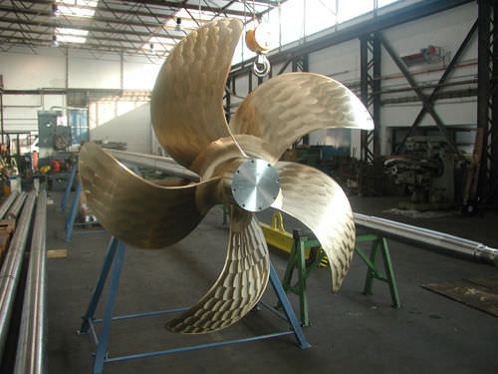
Copper was one of the first metals used by mankind, as it existed in relatively abundant quantities in its natural state in nature. However, today all copper production is obtained from minerals, in the form of sulfides, oxides, and carbonates. Copper is a metal with a more or less dark red color that melts at 1083°C. After silver, it is the best conductor of heat and electricity: its high thermal conductivity is precisely what makes it difficult to weld, since it is somewhat complex to concentrate heat at a specific point as it dissipates very quickly.
It is very ductile and malleable, but its strength and hardness increase greatly when cold-worked. Atmospheric agents form a thin grayish-green film on its surface that reduces further oxidation.
APPLICATIONS OF COPPER.
COPPER ALLOYS.
The copper alloys with the widest range of applications are:
Brass: Contains a maximum of 50% zinc. This addition of zinc simultaneously increases
the mechanical strength and ductility of the alloy, which is unusual in metallurgy since it is common for ductility to decrease as mechanical strength increases and vice versa. Zinc is a metal with a low boiling point, so in order to avoid zinc losses in brasses during welding, the process must be oxyfuel welding or a low heat input process.
These alloys exhibit the essential properties of copper, but at a lower cost and with greater ease of fabrication. Brasses have many applications: for their appearance, in gold imitations for jewelry; for
their ductility, for the manufacture of parts by deformation; for their corrosion resistance, in the manufacture of marine machinery; and due to their lower price compared to bronzes, they substitute bronzes in many manufacturing applications.
Special brasses: In addition to zinc, they contain other elements such as
lead, manganese, and tin. These are alloys used in special applications in marine machinery.
Bronzes: These are alloys of copper and tin (more recently, the term bronze has come to refer
to alloys of copper with any other metal except zinc). Tin in bronzes has a similar influence to zinc in brasses, although more pronounced. Bronzes yield sounder castings than brasses and are more easily worked.
The color also depends on the tin percentage and ranges from pale red to white; their resistance to seawater is lower than that of certain brasses.
The most typical applications of bronzes are: due to their good anti-friction properties, they are used for the manufacture of bearings; due to their excellent corrosion resistance, for the manufacture of propellers; and due to their attractive and lasting appearance, for the manufacture of coins, medals, and decorative items in general.
The most important bronzes are phosphor bronze, aluminum bronze, leaded bronze, and cupronickel.
WELDABILITY.
The weldability of these types of materials is not an easy task, since their main characteristic is heat dissipation; that is, on thick sections a preheat must be applied and maintained so that the weld achieves excellent fusion.
Copper and copper alloys can be welded with any welding process:
MMA-SMAW: Use covered electrodes classified under AWS specification SFA 5.6; do not forget to preheat on thick sections.
GMAW, GTAW, OFW: Use electrodes and wires under AWS specification A5.7. For GMAW and GTAW processes, the use of inert gases such as helium is recommended; use the push technique and do not forget preheat as well as cleanliness, which plays a fundamental role in ensuring the joining process is carried out in the best possible manner. For the OFW process, silver rods or strips at 20%, 40%, 60%, or 99% can be used. These types of welds are referred to as brazing. The process consists of heating the base material and then applying the silver filler with a flux, which melts rapidly by capillary action, generating a strong joint. This type of application is used for joining copper pipes for natural gas transport or connections in air conditioning systems.
Ask the DoctorWelding assistant about this topic and it answers citing our articles.

Metals play a major role today in all areas of society’s development. These materials are present daily in…
Lamellar tearing is the separation in the base metal or matrix caused by through-thickness stresses induced by weld…