No Catergory 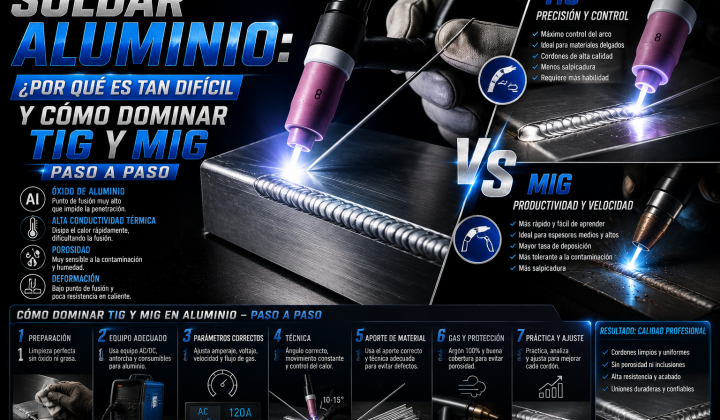
Welding Aluminum: Why It’s So Difficult and How to Master TIG and MIG Step by Step
Beginner's Guide to Aluminum Welding: Oxide Cleaning, Shielding Gas, Polarity, and Equipment Settings for TIG and MIG.

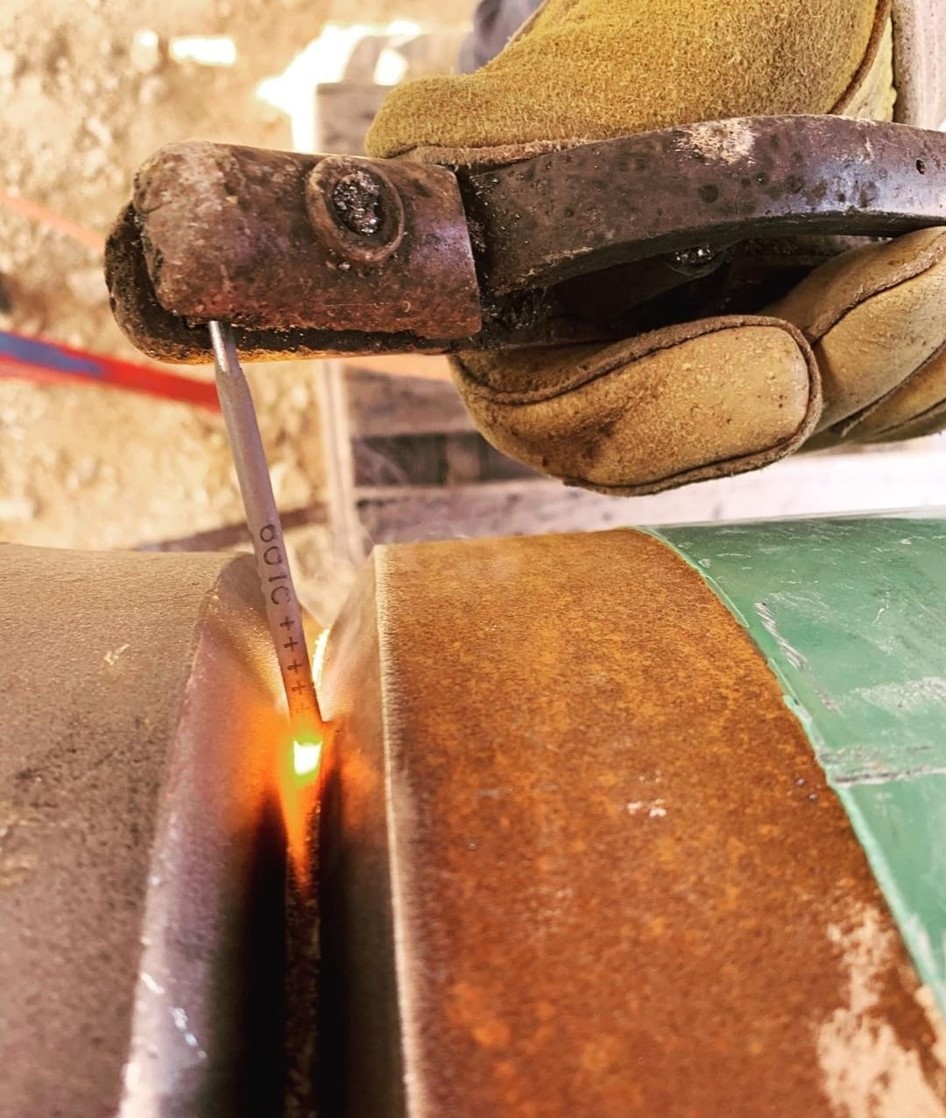
The origin of welding as a technology for joining metallic materials dates back to the Bronze Age, where the earliest traces of welding processes used for ornamental purposes are found. In the Iron Age, pieces of wrought iron have been found that would have been joined by heating and hammering them together, thus developing forge welding.
In the Middle Ages, solid-state welding was used to reduce iron ore to metallic iron without the need to melt it (1,2,3). However, the problem of joining sheet metal was solved by fusion welding, in which a heat source intense enough to melt the edges of both sheets to be joined is moved along the joint. Sufficiently intense heat sources became available on an industrial scale at the end of the 19th century, when oxyfuel gas welding appeared, as well as arc welding and resistance welding.
Consumable electrode arc welding, the most important of the
fusion welding processes, is more complex than the others, which is why its development occurred more slowly. Initially, bare wire electrodes were used, but the resulting weld metal contained high levels of nitrogen, which made it brittle. Coating the wire with asbestos or paper improved the properties of the weld deposits. The feasibility of this process stems from the discovery by Sir Humphry Davy in 1809, according to which electricity can be conducted through air between two carbon (graphite) electrodes, forming what we now know as a gaseous discharge. Later, in 1885, Bernados and Olszewski patented a process where it was possible to reproduce this phenomenon between a carbon electrode and a metal workpiece. As a result of the heat generated, localized fusion is achieved, which can be used to join parts. It was found necessary to supply additional filler metal to fill the gap between the two sheets to be joined, using a rod dipped into the liquid weld pool in electric welding in 1887.
In 1892, Slawianoff reasoned that if the filler rod were used as the cathode instead of the carbon electrode, it would melt due to the heat generated at the cathode, and a much greater proportion of the heat dissipated in the electric arc would enter the weld; however, welds produced by this technique were of very poor quality due to the reaction of the molten metal with the high-temperature arc atmosphere. In this regard, the success of carbon electrode arc welding appears to have been fortuitous, since the carbon electrode, upon arc initiation, generated a CO2 and CO atmosphere that shielded the weld pool from the air, which is rich in oxygen
and nitrogen. This led to the idea of applying protective coatings to the electrode, with the first patents in 1907 being awarded to the Swede O. Kjellberg, who later founded the company ESAB.
An early technique was developed in Britain using asbestos-impregnated cloth wrapped around the metal wire, providing better protection against contamination. In the United States, during World War I, asbestos was not available, and cotton fibers impregnated with wet sodium silicate were used as a substitute; this coating was capable of stabilizing the arc, creating a protective atmosphere against oxygen and nitrogen from the air, and producing a slag — these being the main requirements of a modern electrode coating. In fact, cellulosic electrodes are still in use today.
Thus, welding acquired a position of central importance in the construction of engineering structures. This trend has continued, and since the invention in 1943 of the inert gas shielded welding process, welding processes have developed and multiplied at a great pace, resulting in the vast majority of metallic materials currently used in industry being weldable by one of the existing welding processes. In this way, welding has served to drive development and evolution, since wherever there is metal, there is also a joining process and a welder to carry out that work.
Ask the DoctorWelding assistant about this topic and it answers citing our articles.

Beginner's Guide to Aluminum Welding: Oxide Cleaning, Shielding Gas, Polarity, and Equipment Settings for TIG and MIG.
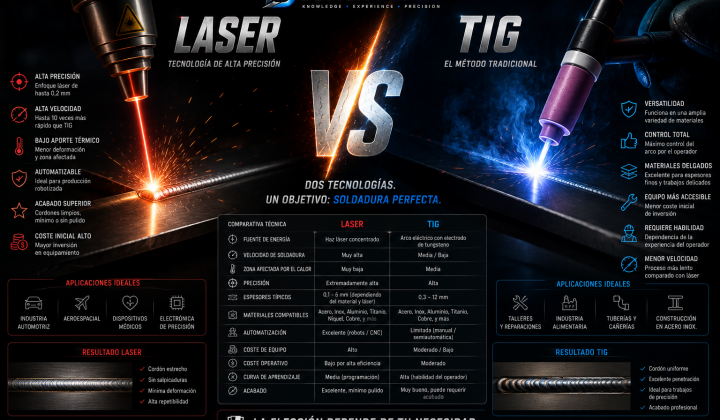
Comparison between laser and TIG welding focusing on the advantages of laser: speed, distortion, penetration, and automation.