No Catergory 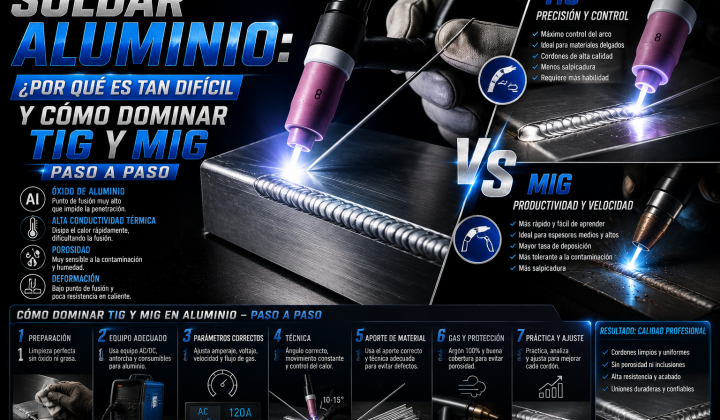
Welding Aluminum: Why It’s So Difficult and How to Master TIG and MIG Step by Step
Beginner's Guide to Aluminum Welding: Oxide Cleaning, Shielding Gas, Polarity, and Equipment Settings for TIG and MIG.
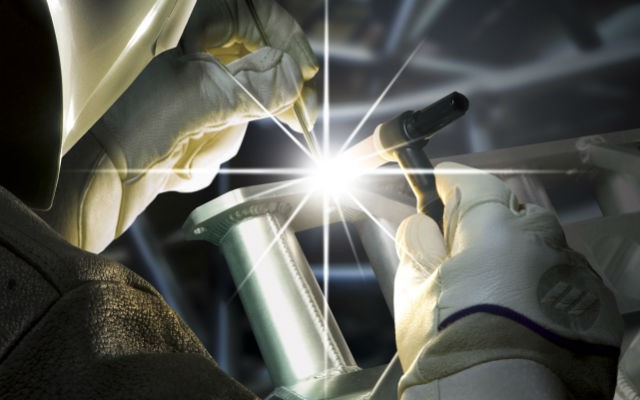
Tungsten inclusions are almost always associated with the GTAW process, which uses a tungsten electrode to establish the arc. If the electrode makes contact with the molten metal, the latter can solidify around the tip; when attempting to remove it, the tip can break off easily and become embedded within the weld metal if it is not removed by grinding.
Inclusions can also occur when the welding currents used are too high relative to those recommended for a particular electrode diameter. In such cases, the current density may exceed that necessary for the electrode to begin to break down, and its fragments are deposited in the weld metal. This can also occur if the welder incorrectly grinds or points the electrode tip.
If the grinding marks are oriented transversely to the electrode axis instead of being aligned longitudinally, they can become stress concentrators that could lead to electrode breakage, most likely at those points.
Other reasons why tungsten inclusions occur may include:
Tungsten inclusions are normally found on the surface of the weld metal unless there has been no opportunity to inspect between passes to detect the presence of such inclusions. If this has not been possible, the only way to detect them is by radiography. Because tungsten is denser than steel and aluminum, it will appear as a bright, well-defined area on the radiographic film. It is essential to detect and correct this defect as early as possible, since it can act as a stress concentrator, triggering an energy release or a future crack. If the project is large in scope, carefully review the radiographic inspections, as this defect can cause severe damage to the welded joint.
Ask the DoctorWelding assistant about this topic and it answers citing our articles.

Beginner's Guide to Aluminum Welding: Oxide Cleaning, Shielding Gas, Polarity, and Equipment Settings for TIG and MIG.
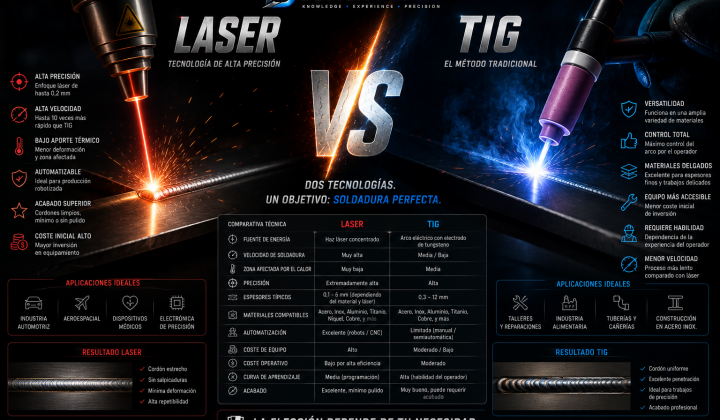
Comparison between laser and TIG welding focusing on the advantages of laser: speed, distortion, penetration, and automation.