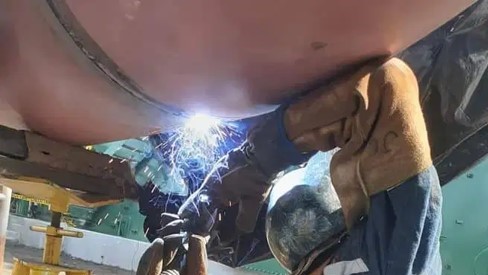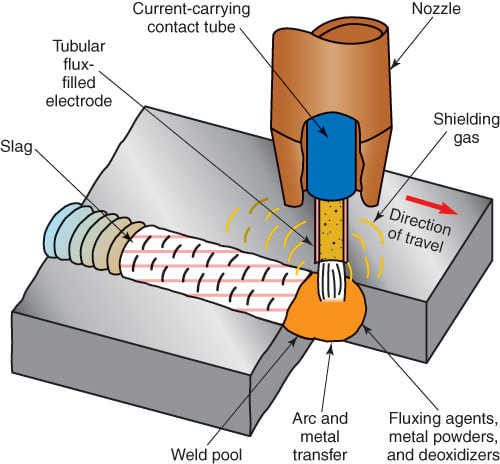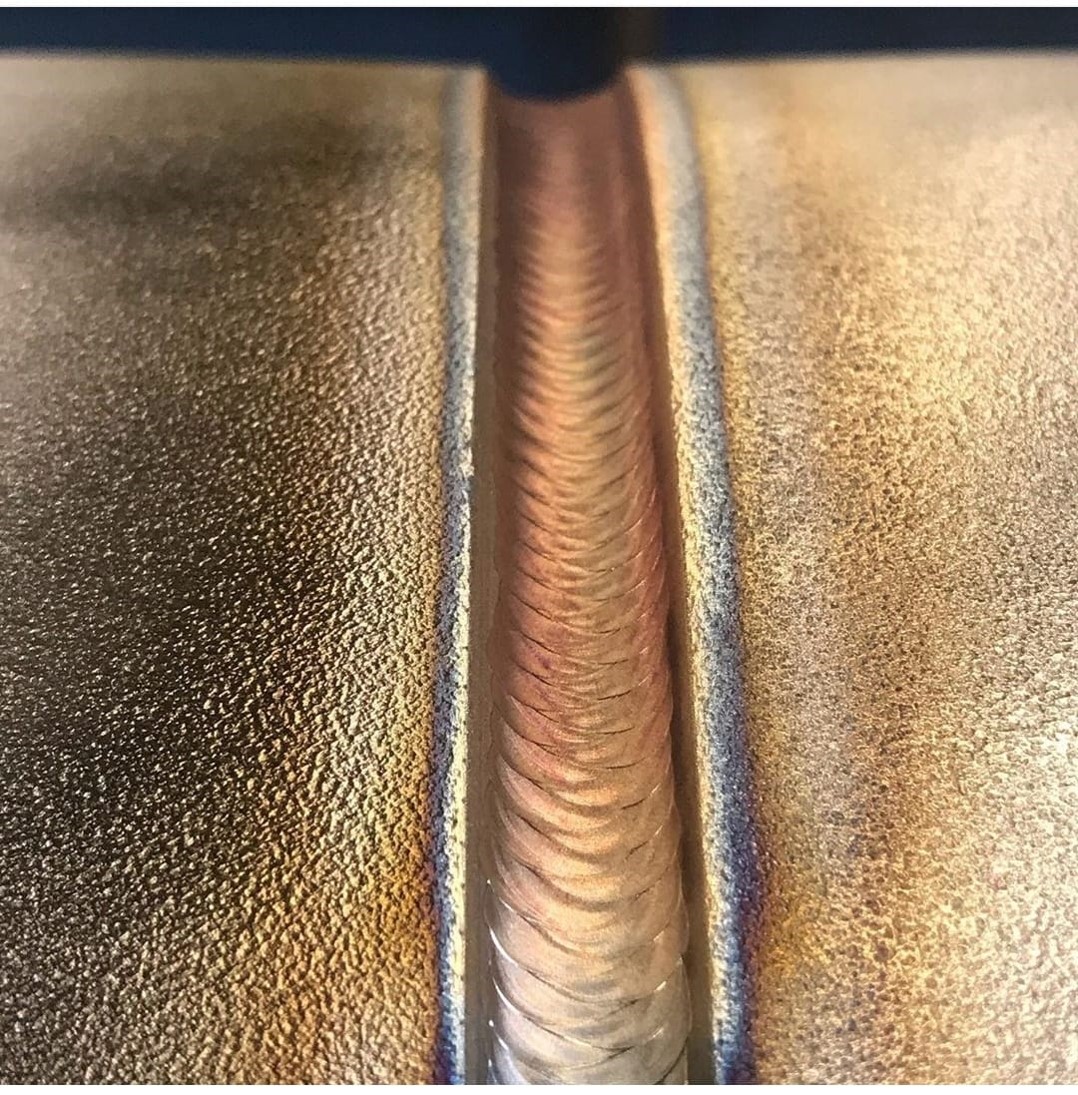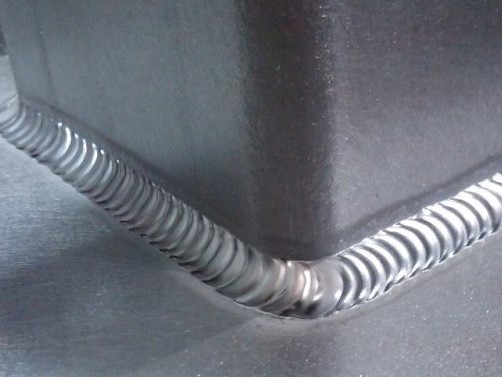
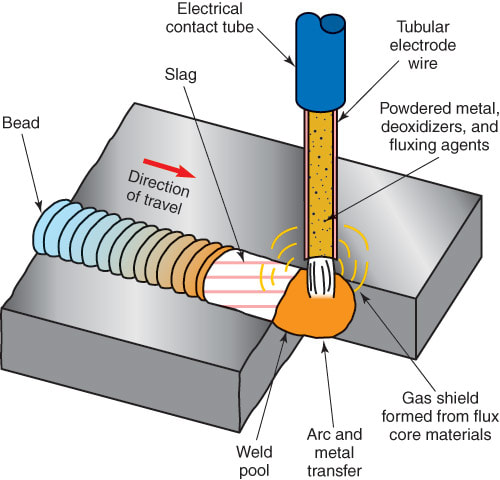
Flux-cored arc welding is a semiautomatic welding process in which the wire used contains flux internally. The flux provides shielding gas for the arc, and a slag layer covers the weld deposit. This process can be used with shielding gas, which may be a mixture of 75% Ar and 25% CO2; CO2 alone can also be used. The choice and use depend on the work to be performed. It is essential to review AWS specifications such as AWS A5.20, A5.29, and ISO 14700.
This process yields very good performance and an efficiency greater than 85%. It is highly versatile for outdoor work, as wires have been developed that require no gas shielding; these wires are known as self-shielded. Its main fields of application include pipelines, structural fabrication, shipbuilding, and more.
The flux-cored wire process encompasses a considerable range of wires and alloys, the most common being: carbon steels, low-alloy steels, stainless steels, and hard-facing overlays. When selecting the process, the power source must be taken into account, since the vast majority of wires operate above 250 amps, requiring welding equipment with adequate capacity and a good duty cycle. The advantages of the process are listed below.
Operational advantages of the Flux Cored Arc Welding process.
- It provides deposition rates up to four times higher than the SMAW process, thereby reducing welding costs on a project by nearly 40%.
- It eliminates the need for equipment to handle and recover flux, as in the SAW process, or for gas equipment, gas storage, piping, and measuring devices, as in the GMAW process. The semiautomatic process is applicable where other mechanized processes would be too inefficient.
- It offers greater tolerance for elements in steel that normally cause weld cracking when welding with the SMAW process. It produces crack-free welds in medium-carbon steels using standard welding procedures. Under normal conditions, it eliminates the moisture absorption and storage problems associated with low-hydrogen covered electrodes. It eliminates losses from covered electrode stubs and the time that would be required to change electrodes with the SMAW process.
- It eliminates the need for wind protection required with gas-shielded welding processes during field construction, and allows the use of fans and high-airflow ventilation systems.
- It enables “single-process” operation, and even “single-process, single-wire” operation, in some shop and field applications. This simplifies operator training, qualification, and supervision, as well as equipment selection and maintenance, and the logistics of efficiently allocating personnel, materials, and equipment to the job.
- It allows application of the long electrode extension principle to enhance deposition rates while enabling the operator to easily control penetration. It allows more passes in a single run, saving welding time and the time that would otherwise be spent on interpass cleaning.
- It provides gap-filling in grooved joints often required when making repairs to welded components or steel castings, delivers mechanized welding speed in confined spaces, and reaches points inaccessible to other semiautomatic processes.
- It provides mechanized welding where it was previously impossible, such as in the joining of a beam web to a column and in building construction, among others. It allows bridging of gaps in fit-up through operator control of penetration without reducing weld quality, and minimizes repairs, delays, and rejections.