No Catergory 
Welding Aluminum: Why It’s So Difficult and How to Master TIG and MIG Step by Step
Beginner's Guide to Aluminum Welding: Oxide Cleaning, Shielding Gas, Polarity, and Equipment Settings for TIG and MIG.

Materials research is today one of the most actively worked disciplines. Emphasis must be placed on the social aspect of materials science and engineering. Throughout this field, it has been repeatedly noted that materials science and engineering currently focuses on meeting humanity’s demands through the creation of tailor-made materials. Consequently, the current state of research addresses both very general human needs and very specific requirements of certain communities.
In the first case, universally applicable results are obtained, and in the second, solutions of local importance that may have little relevance to other communities.
There are many useful examples for providing a general overview of the current state and prospects of materials science and engineering of great worldwide relevance, which are currently being developed with great success in the laboratories of the Materials Research Institute of the National Autonomous University of Mexico (IIM-UNAM).
MEMORY ALLOYS
The first time one hears that a piece of material has “learned” something, one cannot help but prepare to hear some traditional tale or science fiction story in which inanimate objects move on their own, speak, and learn. The inclination to listen to fantasy increases when we are told that, once the material has learned something, it is capable of remembering it. However, our curiosity about such a narrative turns into scientific curiosity when we can witness the following experiment: A strip of brass-like material, shaped like a semicircle, is brought near a flame; it soon begins to straighten until it takes the shape of a ruler, meaning it is now straight. It is then submerged in a glass of water and suddenly curves back to its original semicircular shape. The experiment is repeated over and over, and the strip invariably “remembers” that when exposed to a flame (60°C) it must be straight, and that when exposed to ambient conditions (20°C) it must take the semicircular shape.
Now, if we were asked what name we would assign to such a remarkable phenomenon, I am certain the most appropriate would be: “two-way shape memory,” since the material retains memory of the shapes it must adopt at two well-defined temperatures. What causes the material to behave in this way?
At the microscopic level, the so-called shape memory effect consists of the displacement of atoms in certain alloys when they are rapidly cooled. Technically, this involves a phase transformation known as martensitic transformation, about which little is known and which has been referred to as a “mystery” of Damascus steels. When discussing them, we mentioned as responsible for their hardness a transformation process from a stable high-temperature phase (austenitic) to another generally metastable phase, called martensitic, which occurs as a result of rapid quenching. This transformation has the particular characteristic of taking place without diffusion, that is, without molecular migration. What occurs is simply an organized displacement of atoms, so that the crystal structure is modified.
Although steel was the first material in which this type of transformation was observed, it is not the only one in which it occurs, and this process takes on particular significance when observed in non-ferrous alloys such as nickel-titanium, where it manifests as the shape memory effect. Furthermore, in these alloys it is possible to achieve martensitic transformation not only through temperature changes but also through considerable mechanical stress. For example, a strip (platelet) of nickel-titanium alloy in the austenitic phase (A) at temperature T1: by rapid cooling, the sample is brought to its martensitic phase (M), and the strip will have the same geometric shape but will be in a different phase (martensitic) at temperature T2. If an increasing stress is applied in this phase at temperature T2, the platelet will deform in two stages: first elastically, then continuing to deform by reorientation of grains with different crystallographic orientations. In this second stage, deformations of up to 10% can be achieved without the onset of plastic deformation of the material. Upon removing the stress, the sample is in the following condition: in the martensitic phase, deformed relative to its original shape, without external stress, and at temperature T2. If the temperature is now raised from T2 to T1, the platelet returns to its austenitic phase and recovers its original shape. In other words, the material remembers the phase and shape it had at temperature T1, hence the name “one-way shape memory” effect. There is also the “two-way shape memory” effect, which consists of the material remembering both the geometric shape observed in the austenitic or high-temperature phase and that of the martensitic or low-temperature phase, such that whenever the material is at temperature T1 it will take the shape it “learned” under that condition, and the same will occur at temperature T2.
Ask the DoctorWelding assistant about this topic and it answers citing our articles.

Beginner's Guide to Aluminum Welding: Oxide Cleaning, Shielding Gas, Polarity, and Equipment Settings for TIG and MIG.
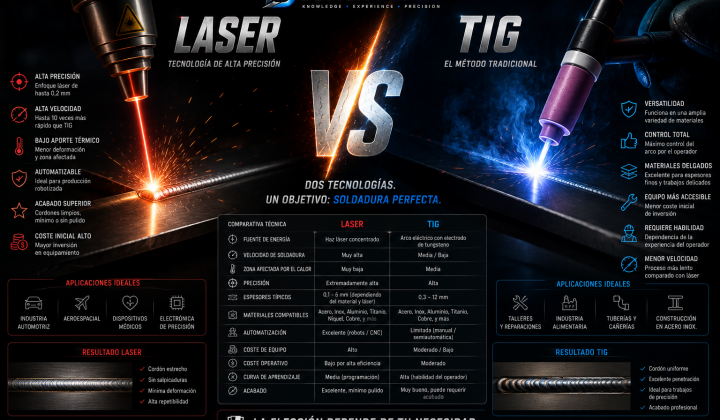
Comparison between laser and TIG welding focusing on the advantages of laser: speed, distortion, penetration, and automation.