WELDING PROCESS 
CAN ALUMINUM BE WELDED WITH THE MIG/MAG PROCESS?
The answer is very simple: yes, it is possible. In fact, since the early development of the GMAW…

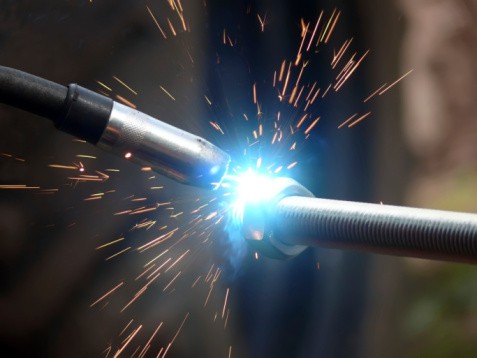
Shielding gases are used in GTAW, GMAW, and FCAW processes. AWS does not provide general specifications for the use of gases in welding processes. In some countries, federal specifications exist, although the welding industry typically relies on “welding grade” to describe the required purity.
The primary purpose of a shielding gas is to protect the molten weld metal from contamination by oxygen and nitrogen in the air. Welding shielding gases influence arc characteristics and metal transfer during welding; factors such as penetration, bead width, and bead profile improve weld bead appearance. They are also relevant with respect to welding speed variables and the tendency toward undercutting.
Among the inert gases are: Helium, Argon, Neon, Krypton, and Xenon; the only ones sufficiently abundant for practical use in welding are helium and argon. These gases provide satisfactory shielding for the most reactive metals, such as aluminum, magnesium, beryllium, columbium, tantalum, titanium, and zirconium.
Although pure inert gases protect the metal at any temperature from reaction with air constituents, they are not suitable for all welding applications.
Controlled amounts of reactive gases mixed with inert gases improve arc action and metal transfer characteristics when welding steels, although such mixtures are not used for reactive metals.
Oxygen, nitrogen, and carbon dioxide are reactive gases. With the exception of carbon dioxide, these gases are not generally used alone to shield the arc. Carbon dioxide may be used alone or mixed with an inert gas to weld many carbon and low-alloy steels. Oxygen is used in small quantities with one of the inert gases, usually argon, specifically for welding stainless steels with the GMAW process. Nitrogen is occasionally used alone, although it is usually mixed with argon as a shielding gas for welding copper. The most extensive use of nitrogen is in Europe, where helium is not as readily available.
ARGON AND HELIUM
As noted, the inert nature of argon and helium are not the only characteristics that make them suitable as shielding gases. The other characteristics are important and are decisive factors in the selection of the gas for welding in GTAW or GMAW processes with specific materials.
For a given arc length and current, the arc voltage with helium is higher than with argon. Due to its higher ionization potential, more heat is generated with helium than with argon; helium is more effective for welding thick materials and those with a high degree of thermal conductivity, particularly metals such as copper and aluminum alloys. Argon is more suitable for welding thin materials and those with lower thermal conductivity, especially in welding positions other than flat.
The heavier a gas is, the more effective it is at shielding the arc. Helium is very light; argon is approximately 10 times heavier than helium and nearly 30% heavier than air. When argon is discharged from the welding nozzle, it forms a protective blanket over the weld area, whereas helium rises and disperses rapidly. For this reason, higher flow rates are required with helium or helium-rich mixtures than with argon shielding.
The shape of a weld bead and the penetration pattern are determined, to a great extent, by the metal transfer characteristics, which are affected by the shielding gas used.
Metal is generally deposited either by spray transfer or by globular transfer. Spray transfer, usually the most desirable, produces relatively deep penetration at the center of the bead and shallow penetration at the edges; globular transfer produces a wider and shallower penetration pattern across the full width of the bead, with the drawback of a high spatter rate.
Argon generally promotes spray transfer more readily than helium and at lower current levels. But even with argon shielding, spray transfer cannot always be achieved at typical current levels; this is one of the challenges in welding ferrous metals using the GMAW process.
INERT GASES WITH REACTIVE GAS ADDITIONS
Improved metal transfer and a more stable, spatter-free arc are achieved by adding oxygen or carbon dioxide to an inert shielding gas. These mixtures are used when welding carbon and low-alloy steels; they also promote wetting and flow of the weld metal, thereby reducing or eliminating undercutting.
The addition of 5% oxygen or between 10 and 25% carbon dioxide to argon produces a smoother transfer effect, generating droplet detachment with significantly reduced spatter.
Carbon Dioxide
Carbon dioxide may be used as a shielding gas for GMAW welding of carbon and low-alloy steels; however, because it is a reactive gas, the electrode wires used must contain sufficient deoxidizers to counteract the effects of oxygen. High-silicon stainless steel electrode wires have been developed for use with argon + 25% carbon dioxide mixtures.
The low cost of carbon dioxide makes its use as a shielding gas very attractive. With the development of improved electrode wires, sound weld deposits with good mechanical properties can be achieved.
Two types of metal transfer occur with carbon dioxide as a shielding gas: globular and short-circuit. The spray transfer experienced with argon or argon + oxygen mixtures does not occur.
Globular transfer produces a rough arc with excessive spatter; by controlling welding conditions, short-circuit metal transfer is promoted.
To promote short-circuit metal transfer when welding carbon and low-alloy steels, argon is often used as the predominant gas in a mixture, with a carbon dioxide content between 20 and 30%. Other mixtures with higher percentages of carbon dioxide also provide short-circuit transfer, with its advantages of low penetration, all-position capability, and the ability to handle poor fit-up on thin-gauge materials without burn-through.
Ask the DoctorWelding assistant about this topic and it answers citing our articles.

The answer is very simple: yes, it is possible. In fact, since the early development of the GMAW…
Stainless steels are a group of materials whose main characteristic is corrosion protection, due to their CHROMIUM content,…