No Catergory 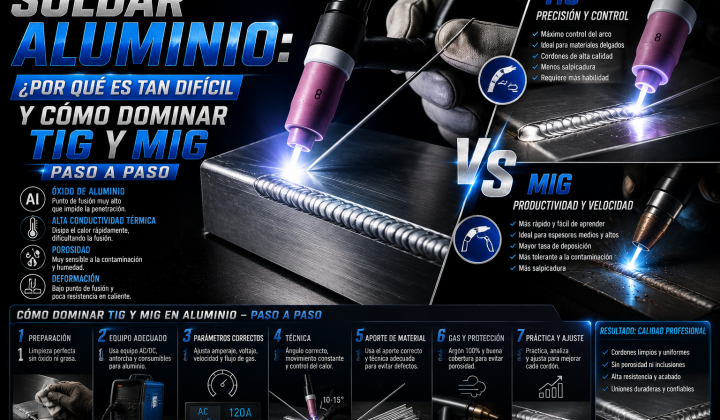
Welding Aluminum: Why It’s So Difficult and How to Master TIG and MIG Step by Step
Beginner's Guide to Aluminum Welding: Oxide Cleaning, Shielding Gas, Polarity, and Equipment Settings for TIG and MIG.

Aluminum is one of the most modern metals when compared to metallurgy practiced more than 5,000 years ago. It was at the beginning of the 19th century when Danish chemist Hans Christian Oersted isolated the metal for the first time in 1825 through a chemical process using an amalgam of potassium and aluminum chloride. German chemist Wöhler obtained it in powder form in 1827 by reacting potassium with aluminum chloride, and later in 1845, he himself determined for the first time the properties of the newly discovered metal, its density and lightness, and separated it in the form of small pellets. Aluminum is extremely abundant in the composition of the Earth’s crust, found in an approximate proportion of 15%, surpassed only by silica. The most significant industrial mineral is “bauxite,” with an alumina content (aluminum oxide Al2O3) of between 55 and 65%, found mainly in tropical regions. This mineral was discovered by M. Pierre Berthier, who named it after the place where he found it, the village of Les Baux-de-Provence, in Arles, southern France.
Bauxite is found in Spain, but in very small quantities in Teruel, Barcelona, Tarragona, and Lleida. In 1854, Bunsen succeeded in preparing aluminum electrolytically, using sodium aluminum chloride as the starting compound in his experiments. That same year, Henri Sainte-Claire Deville improved the process and for the first time in history manufactured aluminum by replacing potassium with sodium, presenting it at the Paris Exhibition of 1855 in the form of ingots. It can therefore be said that Deville was the pioneer of the industrial production of the metal, whose process, with minor modifications, was used until 1888, when it was replaced by the electrolytic method. The founders of the great aluminum industry were Héroult, German chemist Kiliani, and American Charles Martin Hall; the former founded the Aluminium Industrie Aktien Gesellschaft in 1888.
About forty years after the founding of the aluminum industry, the first major aluminum production plant in Spain was established in 1929, located in Sabiñánigo (Huesca). Current production in Spain is located in San Ciprián (Lugo), La Coruña, and Avilés. Aluminum is a metal too reactive to exist in its free state, and in nature it is found combined with a large number of minerals, the main ones being bauxite and cryolite. Bauxite is the most important of the aluminum minerals; it is a hydroxide whose composition does not correspond to a specific chemical formula, as it is always found combined with varying amounts of elements such as iron, silicon, and titanium, along with a variable amount of water of crystallization. Its color ranges from garnet to pure white. Cryolite is, along with bauxite, the most important mineral in the manufacture of aluminum, its main role being that of a flux for alumina in electrolytic baths. Cryolite is currently being replaced by synthetic ciolite, an artificial fluoride of aluminum, sodium, and calcium.
HOW IS IT MADE?
The extraction of aluminum from bauxite is carried out in three stages: mining, refining, and reduction. The bauxite is extracted, washed, and dried before being sent to the refinery where it is separated from the aluminum. The Bayer Process — developed by Josef Bayer (Austria), son of the Bayer Chemical Company — was invented for the large-scale production of alumina from bauxite. This method is the most widely used in the aluminum industry. Starting from bauxite, which has been previously dried and finely ground, the material is heated with a concentrated solution of caustic soda (NaOH) to obtain a solution of sodium aluminate (AlO2Na) and some sodium silicate (Na2SiO2). This solution is filtered and aluminum hydroxide (Al(OH)3) is precipitated, either with carbon dioxide or with a small amount of previously precipitated aluminum hydroxide. The alumina is reduced to aluminum in electrolytic cells using the Hall-Héroult process. In these cells, molten cryolite at 980°C is used to dissolve the alumina, which upon electrolysis is split into aluminum and oxygen. The aluminum sinks to the bottom of the cell, where it is periodically tapped, while the oxygen combines with the carbon of the anode to produce CO2. Through the action of the supplied electric current, the alumina introduced into the electrolytic cell or furnace is decomposed, and in accordance with the laws governing electrolysis, aluminum is deposited at the negative electrode (cathode), which consists of the furnace lining; from here the metal is extracted and cast in the form of rolling slabs, billets for extrusion, or ingots for foundry use. In accordance with the same laws, oxygen is produced at the positive electrode (anode), which, due to its high reactivity, reacts with the carbon of that electrode, forming the gaseous by-products carbon monoxide and carbon dioxide (CO and CO2). This reaction causes anode consumption, so the anodes must be replaced periodically. The anode blocks are made of carbon. To produce 1,000 kg of aluminum, 10,000 kg of bauxite are required, yielding 500 kg of alumina, 80 kg of cryolite, and 600 kg of carbon, plus 14,000 kWh of electrical energy. Due to their high electrical consumption, aluminum electrolysis plants are built near locations where energy is cheaper, such as hydroelectric power stations, nuclear plants, or oil-producing countries.
Ask the DoctorWelding assistant about this topic and it answers citing our articles.

Beginner's Guide to Aluminum Welding: Oxide Cleaning, Shielding Gas, Polarity, and Equipment Settings for TIG and MIG.
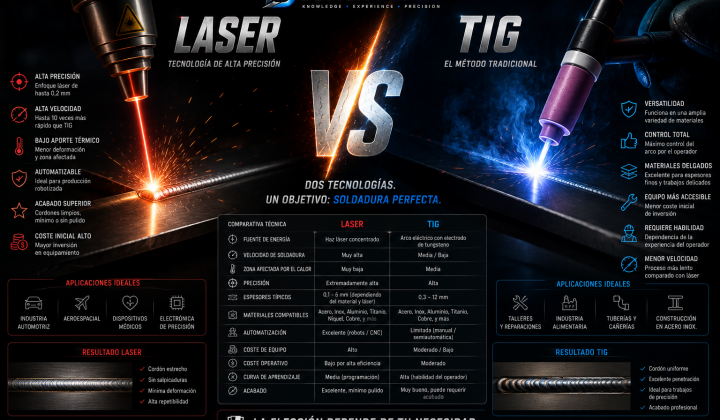
Comparison between laser and TIG welding focusing on the advantages of laser: speed, distortion, penetration, and automation.