WELDING PROCESS 
CAN ALUMINUM BE WELDED WITH THE MIG/MAG PROCESS?
The answer is very simple: yes, it is possible. In fact, since the early development of the GMAW…

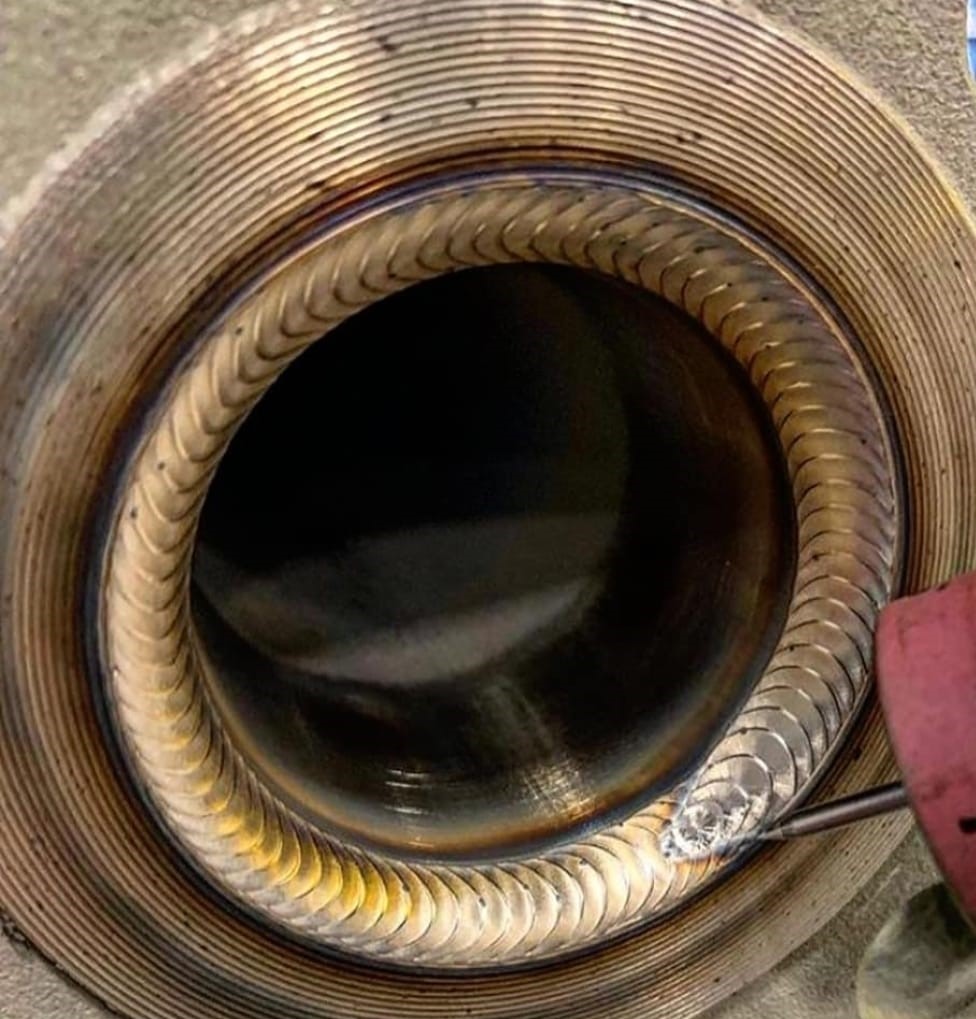
The GTAW or TIG process is considered one of the most versatile of all welding processes. It can be used to make high-quality welds on almost any metal, in any position, and on almost any thickness of sheet, plate, or pipe. For example, Ernest Levert, a welding engineer working on the thermal control units (heat rejection panels) for the international space station, has welding equipment that produces manual GTAW process applications on stainless steel and Inconel tubing in diameters ranging from 3.175 mm to 25.4 mm (1/8″ to 1″) with a wall thickness of 0.71 mm (0.028″). Tens of thousands of these tiny welds have been successfully completed during the production of these panels at the Lockheed Martin Vought Systems facility in Grand Prairie, Texas.
The GTAW or TIG welding process has several advantages over most other welding processes; it is a very clean and versatile process that leaves no slag, as occurs in most other welding processes, so no post-weld cleanup is required. The versatility of the process is demonstrated by its ability to be used on welds in almost any metal, of any thickness, and in any position. Before gas tungsten arc welding (TIG) was developed, metals such as aluminum and magnesium were very difficult or impossible to weld. Welds made on these metals had poor mechanical properties: they were highly porous and had very low corrosion resistance.
The first major change that occurred with the new process was the development of a more cost-effective shielding gas than helium: argon.
Argon is a byproduct of oxygen production. Working with argon as a shielding gas, technicians developed the process by switching from direct current electrode positive (DCEP) to direct current electrode negative (DCEN). Currently, direct current electrode negative (DCEN) is the most widely used type in the GTAW process due to arc stability and high heat input to the workpieces. With this change, gas tungsten arc welding became the most popular method for producing joints in metals considered difficult to weld, such as aluminum, magnesium, titanium, and certain grades of stainless steel. The greatest disadvantage, in terms of wider use, is that it is costly; manual GTAW welding is quite time-consuming, which represents an increase in the overall cost of the product. Advances in automation with the GTAW process have reduced these costs somewhat; however, it is still considered a relatively expensive process compared to other joining methods. These expenses are often considered minor in relation to the high-quality welds produced. There are some welds that can typically only be made using this process. Most GTAW welds are performed on materials with thicknesses less than 6 mm (0.25″). Performing GTAW welds requires good hand-eye coordination, very similar to that required for oxyfuel welding. GTAW welding is often easier to learn if a person already knows how to weld with oxyfuel gas, although gas welding is not a prerequisite for learning GTAW welding skills.
Sources of weld contamination in the GTAW process.
Since gas tungsten arc welding uses no flux, it can easily become contaminated from several sources. The main potential sources of contamination are the following:
• Filler metal. The weld can be contaminated by oil, dirt, grease, or oxides present on the surface of the filler metal.
• Shielding gas. The weld can be contaminated by air or oxygen from moisture in the shielding gas, picked up due to a leak at a faulty connection or from water dripping in the torch.
• Base metal. The weld can be contaminated by surface oxides or inclusions present on or in the base metal that are released during the process.
• Welder’s hands. The weld can be contaminated by oils and dirt from the welder’s hands while handling filler metals or plates.
Ask the DoctorWelding assistant about this topic and it answers citing our articles.

The answer is very simple: yes, it is possible. In fact, since the early development of the GMAW…
Stainless steels are a group of materials whose main characteristic is corrosion protection, due to their CHROMIUM content,…