No Catergory 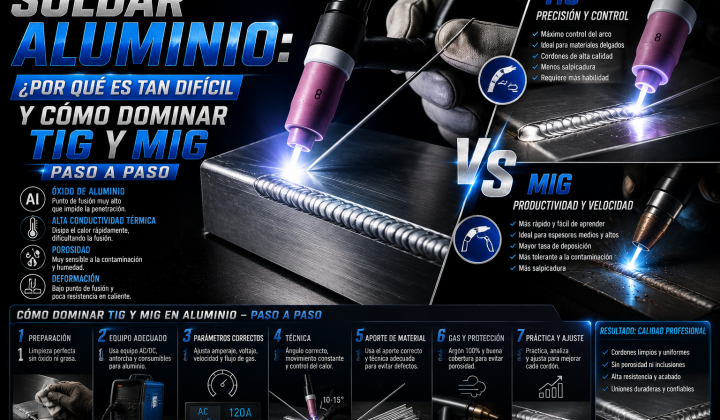
Welding Aluminum: Why It’s So Difficult and How to Master TIG and MIG Step by Step
Beginner's Guide to Aluminum Welding: Oxide Cleaning, Shielding Gas, Polarity, and Equipment Settings for TIG and MIG.
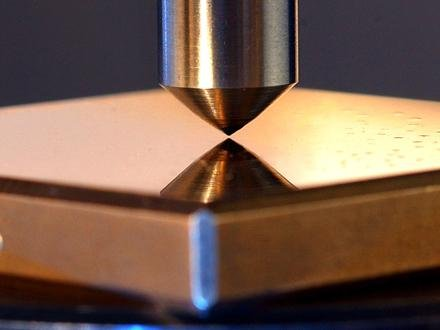
Technical definition of Hardness: “The greater or lesser resistance that a body opposes to being scratched or penetrated by another” or “the greater or lesser hardness of a body with respect to another taken as a reference element.”
Indentation test:
Defines hardness as the resistance to indentation or resistance to plastic deformation that a material opposes when pressed by a specific indenter under the action of predetermined loads.
BRINELL HARDNESS.
It consists of pressing a hardened steel ball against the surface of the material to be tested for a certain time (t), producing an impression in the form of a spherical indentation.
It is obtained by dividing the applied load by the surface area of the indentation.



Test constant: hardness will be a function of the test load and the ball diameter.
P / D² = const.
INDENTERS:
Steel ball diameters 15; 5; 2.5; 2; 1 mm. steel up to 450HB, carbide (tungsten) up to 630 HB
*Application time: Steels =>15 sec., soft metals =>30 sec.
(no dynamic effects should occur)
*Loads used: 3000 kgf – 1500 kgf – 500 kgf
ROCKWELL HARDNESS.
Hardness is calculated based on the depth of penetration and the total load is not applied continuously. There is a preliminary load and an additional load (which varies depending on the test conditions).
The value is read directly from the dial indicator. Hardness is given by the increment in penetration depth due to the action of the additional load once it has been removed.

The preliminary load is 10 KGF and the additional loads are 50, 90, and 140 KGF; the indenters used are: 1/16″, 1/8″, ¼”, and ½” balls or a diamond cone. The most commonly used scales are HRC (with diamond cone and 150 kgf load) and HRB (with a 1/16″ ball and 100 kgf load).
VICKERS HARDNESS.
It is similar to the Brinell test, meaning its value depends on the applied load and the surface area of the indentation. Loads range from 1 to 120 kgf and the indenter is a diamond tip with a pyramidal shape.


Ask the DoctorWelding assistant about this topic and it answers citing our articles.

Beginner's Guide to Aluminum Welding: Oxide Cleaning, Shielding Gas, Polarity, and Equipment Settings for TIG and MIG.
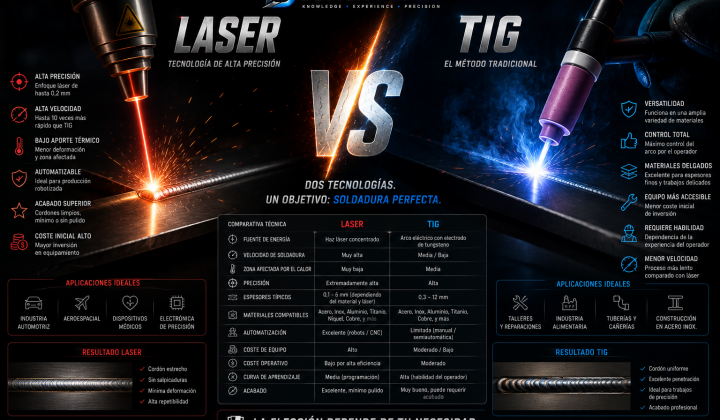
Comparison between laser and TIG welding focusing on the advantages of laser: speed, distortion, penetration, and automation.