WELDING PROCESS 
CAN ALUMINUM BE WELDED WITH THE MIG/MAG PROCESS?
The answer is very simple: yes, it is possible. In fact, since the early development of the GMAW…

HISTORY
Thermal spraying is a material protection process that emerged in the early 20th century. Its first applications were for corrosion protection through the application of zinc; however, despite having existed since that time, it was not until after the 1960s that significant development began, which changed the process’s predominantly repair-oriented nature and evolved it to integrate it into the production process, especially for aircraft components and the textile industry, with the consequent expansion in equipment, processes, and products for carrying it out.
WHAT IS IT?
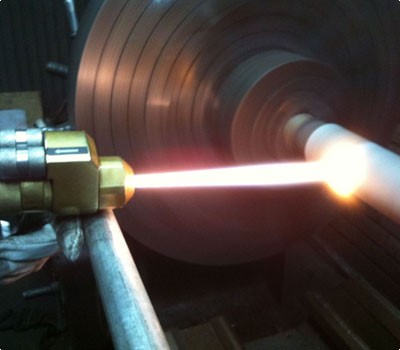
Thermal spraying (THSP) is a group of processes by which finely divided particles of metallic or non-metallic coating materials are deposited in a molten or semi-molten state onto a substrate to form a thermal spray deposit. The coating material may be in the form of powder, wire, or rod. The material to be sprayed is heated and brought to a molten or plastic state by a heat source such as gas combustion, electric arc, plasma arc, or the detonation of an explosive mixture. The heated material is projected onto the substrate by a gas stream. Most metals, ceramics, and hard compounds can be thermal sprayed using one of the process variations.
The substrate is generally prepared by grit blasting with aluminum oxide or angular white iron to increase surface roughness.
When the molten particles impact the surface, they flatten to form small splats that interlock with the surface irregularities and with each other. These splats cool rapidly and solidify, forming a layered structure that builds up until the desired final dimension is achieved.
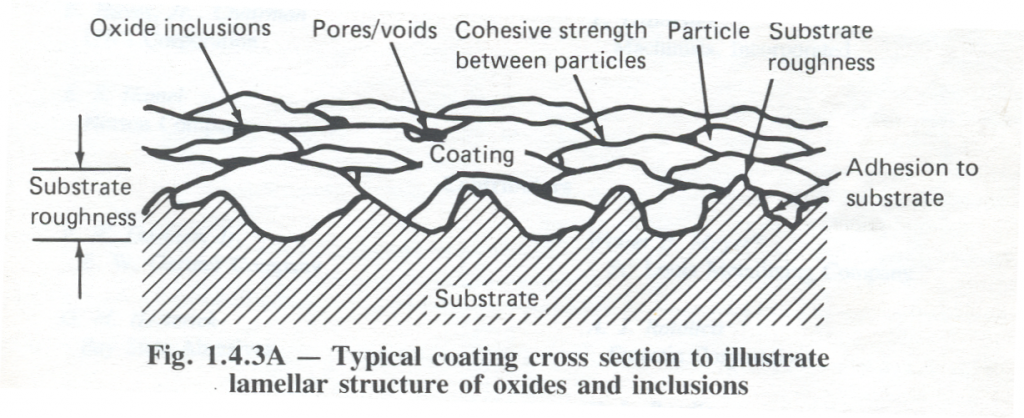
The bond between the substrate and the coating material may be mechanical, metallurgical, chemical, or a combination of these. In some cases, a subsequent heat treatment of the coating increases bond strength to the substrate through diffusion or chemical reaction with the substrate.
The density of the deposit depends on factors such as the type of material, the process, etc. It is generally greater than 90% of the density of the feedstock material.
WHAT IS IT USED FOR?
Thermal spraying is used extensively in manufacturing, as is the case in the aeronautical industry, which has developed hundreds of applications in which thermal spraying imparts wear resistance and special surface characteristics that are difficult to achieve by other means. On the other hand, industry in general saves thousands of dollars annually through the reconstruction and reconditioning of equipment parts by means of thermal spraying. Today it is well known that the best protection achievable against atmospheric corrosion is through thermal spraying of zinc or aluminum combined with sealants that fill the porosity of the deposit. These sealants are also used in pressure-bearing applications, such as hydraulic systems on heavy equipment.
WHEN IS IT NOT RECOMMENDED?
Due to its lamellar nature and the bonding characteristics with the substrate, thermal spray coatings have a number of limitations in terms of their ability to withstand point loads, impact, or function as a protective barrier against corrosion. The design engineer must take these limitations into account, as well as the inherent differences from processes such as electric arc welding, since thermal spray coatings do not restore the ability to transfer mechanical load — they are coatings that restore and recondition surfaces. Therefore, thermal spraying is not recommended for joining parts, as it has been developed for coating applications.
HOW ARE THERMAL SPRAY COATINGS STRUCTURED?
Success in the use of thermal spray coatings depends on strict adherence to the specific process procedures. Any deviation from these procedures or lack of attention during their execution can result in process failure. There are many variables that combine and interact to produce the final result; these are, in general terms: the feedstock material, the energy source, the spray unit, the particle velocity, and the substrate conditions.
In upcoming articles, we will discuss the types of heat sources and methods used to carry out this process, which is widely used across different industry sectors.
Ask the DoctorWelding assistant about this topic and it answers citing our articles.

The answer is very simple: yes, it is possible. In fact, since the early development of the GMAW…
Stainless steels are a group of materials whose main characteristic is corrosion protection, due to their CHROMIUM content,…