No Catergory 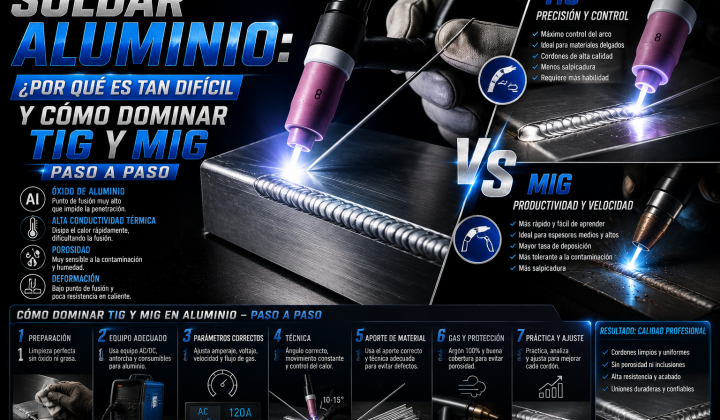
Welding Aluminum: Why It’s So Difficult and How to Master TIG and MIG Step by Step
Beginner's Guide to Aluminum Welding: Oxide Cleaning, Shielding Gas, Polarity, and Equipment Settings for TIG and MIG.
1.- Identify the base metal.
2.- Know the type of current available for welding, that is, whether direct or alternating current is available.
3.- Know the position in which the weld must be performed.
4.- Know the thickness and shape of the base metal.
5.- Know the joint design.
6.- Know the service specifications required for the joint.
7.-Know the efficiency and deposition rate of each electrode.
Once the electrode has been selected according to the above criteria, it is necessary to select the current (amperage) at which it will be operated according to its diameter. If the operating current is direct or continuous, the polarity recommended by the manufacturer must be used.
Even though the different types of electrodes for various applications have different operating characteristics, there are some general implicit rules that apply without exception to all types of covered electrodes.
WELDING ELECTRODES ACCORDING TO THE BASE MATERIAL TO BE WELDED
Ask the DoctorWelding assistant about this topic and it answers citing our articles.

Beginner's Guide to Aluminum Welding: Oxide Cleaning, Shielding Gas, Polarity, and Equipment Settings for TIG and MIG.
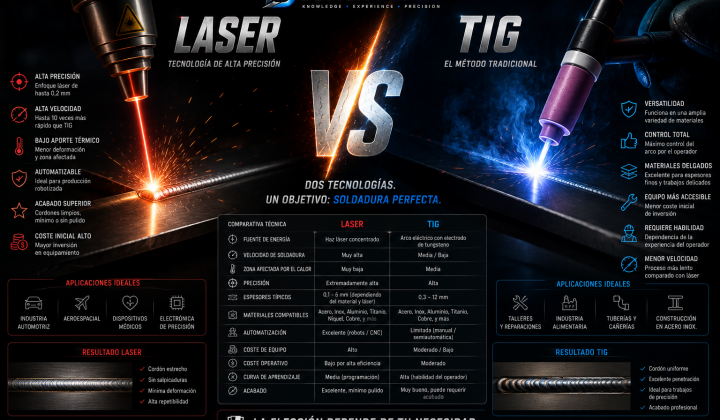
Comparison between laser and TIG welding focusing on the advantages of laser: speed, distortion, penetration, and automation.