No Catergory 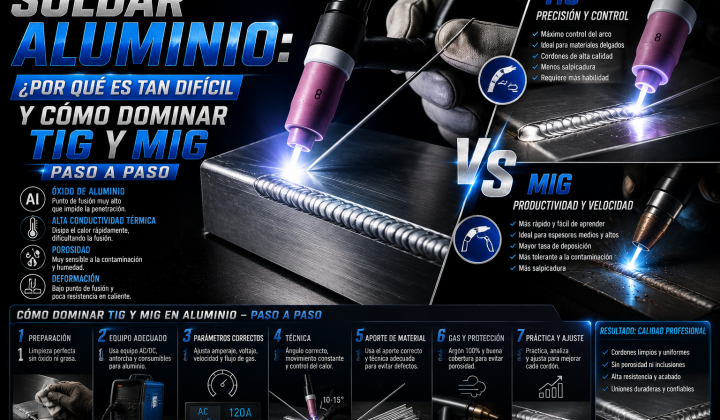
Welding Aluminum: Why It’s So Difficult and How to Master TIG and MIG Step by Step
Beginner's Guide to Aluminum Welding: Oxide Cleaning, Shielding Gas, Polarity, and Equipment Settings for TIG and MIG.

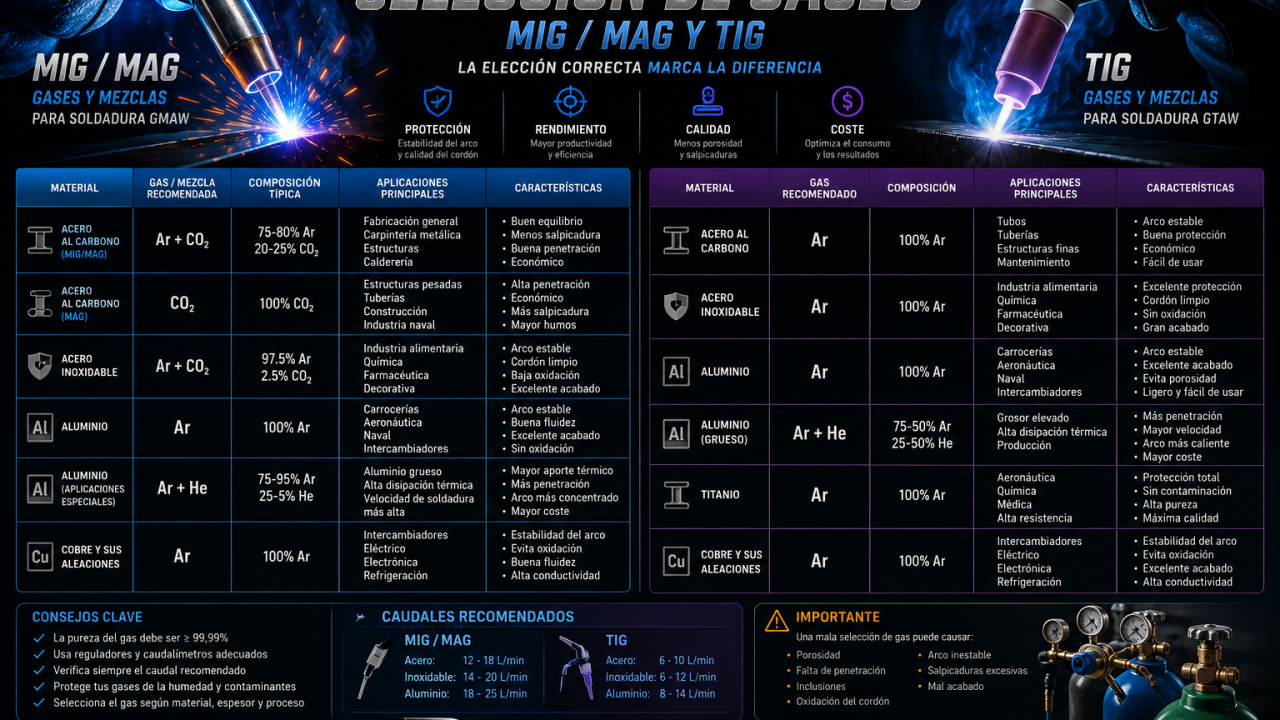
Shielding gas is not a mere accessory: it determines arc stability, penetration, spatter, bead appearance, and even the mechanical properties of the joint. Choosing the wrong gas can ruin an otherwise flawless weld. In this draft we review the most common mixtures of argon (Ar), carbon dioxide (CO₂), and helium (He), and how they perform depending on the base material and welding position.
The common mnemonic: MIG = inert gas (Ar/He), MAG = active gas (mixtures with CO₂ and/or O₂), TIG = always inert.
The table below summarizes reference combinations. All percentages and flow rates must be confirmed against the wire manufacturer’s data sheet and the applicable WPS.
| Material | Indicative mixture | Primary effect | Typical flow rate |
|---|---|---|---|
| Carbon steel (thin sheet) | Ar + 15–20% CO₂ | Good penetration/spatter trade-off | L/min |
| Carbon steel (medium/heavy thickness) | Ar + 20–25% CO₂ or 100% CO₂ | Higher penetration; more spatter with 100% CO₂ | L/min |
| Stainless steel | Ar + 2% CO₂ or Ar + ~2% O₂ | Clean bead, low oxidation, good finish | L/min |
| Aluminum and alloys | 100% Ar (thin/medium thickness); Ar+He for heavy sections [VERIFY] | He increases heat input and penetration | L/min (higher with He) |
| Copper and alloys | Ar + He in proportion according to thickness | Compensates for high thermal conductivity | L/min |
In TIG welding the shielding gas must be inert to avoid attacking the tungsten electrode. The most common options are:
The backing gas in TIG welding of stainless steel is typically argon to prevent root oxidation.
Welding position affects weld pool behavior, and the shielding gas can either help or hinder control:
Technical draft pending expert review. Verify all parameters, percentages, flow rates, and normative references before publishing.
Safety: Shielding gases displace oxygen: work in well-ventilated areas to prevent asphyxiation, especially in confined spaces. Ar+H₂ mixtures are flammable and must be used on austenitic stainless steels only, in accordance with a qualified procedure; never on carbon steels or aluminum. Helium, being lighter than air, can accumulate in overhead areas. Ensure cylinders are properly secured and that appropriate pressure regulators are used. [VERIFY safety requirements and flow rates per manufacturer guidelines and local regulations].
Ask the DoctorWelding assistant about this topic and it answers citing our articles.

Beginner's Guide to Aluminum Welding: Oxide Cleaning, Shielding Gas, Polarity, and Equipment Settings for TIG and MIG.
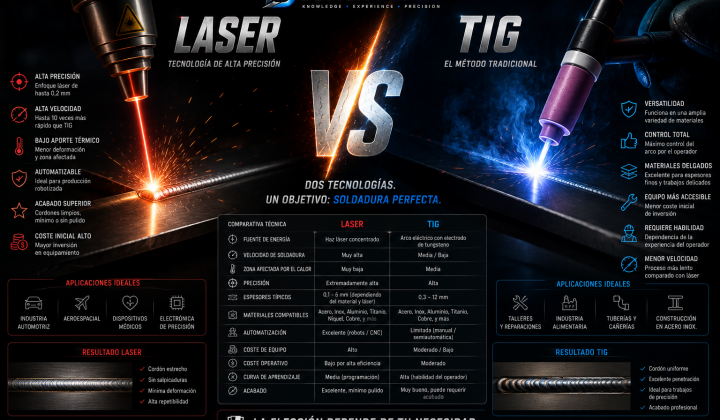
Comparison between laser and TIG welding focusing on the advantages of laser: speed, distortion, penetration, and automation.