No Catergory 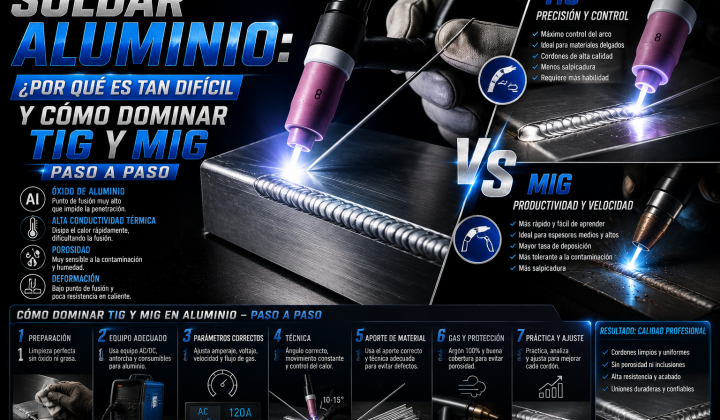
Welding Aluminum: Why It’s So Difficult and How to Master TIG and MIG Step by Step
Beginner's Guide to Aluminum Welding: Oxide Cleaning, Shielding Gas, Polarity, and Equipment Settings for TIG and MIG.
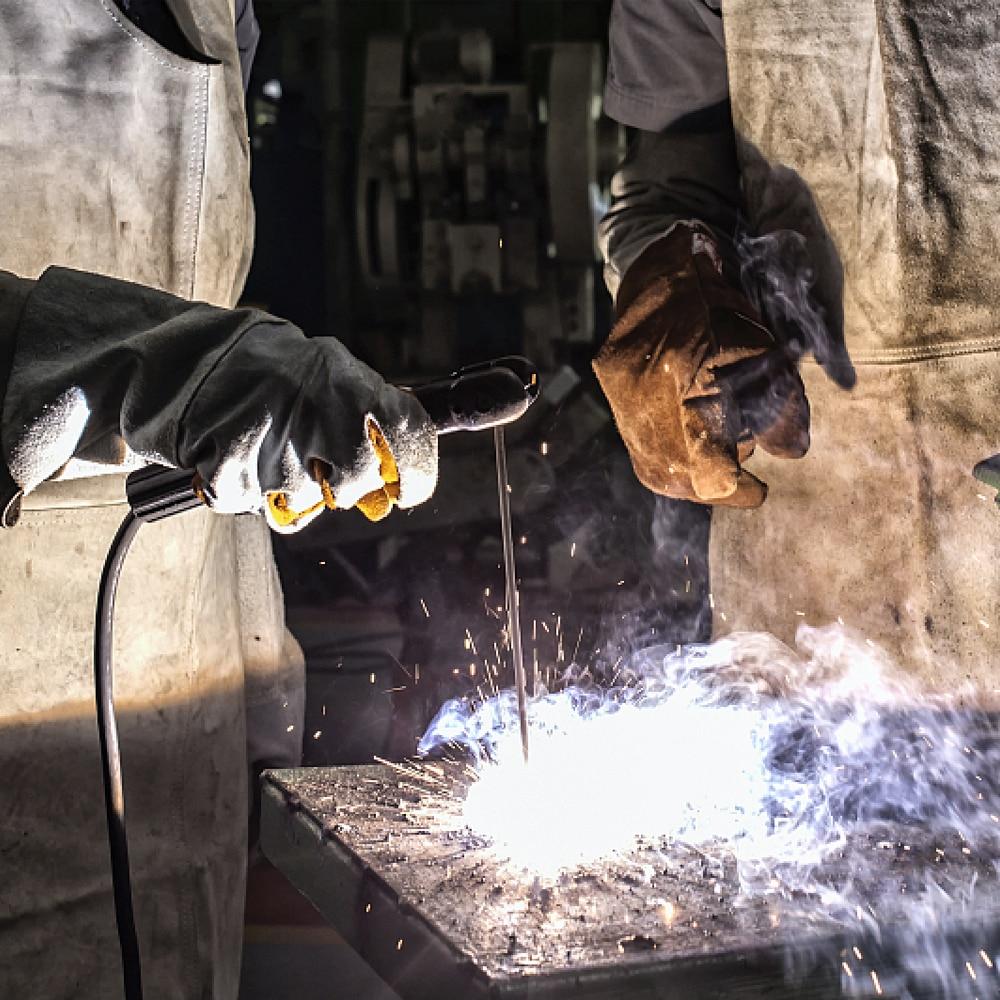
In a material joining process, it is essential to know the variables to be used, and the welding equipment is the main tool for carrying out quality work. On the market, there are different types of machines and different brands, making the purchase of a machine a not-so-easy selection task. That is why there are a number of elements that must be considered when selecting a good power source. For example:
Another determining factor when choosing a power source or welding equipment is analyzing what type of technology the brand has developed. Let us review the types of power sources according to their technology.
Transformer machines: they are called this way because they reduce the voltage from the main power supply and increase the amperage through devices that stabilize the current flow to a voltage that allows welding. They consist of two coils — a primary and a secondary — on a magnetic metal core built from silicon steel laminations. However, welding with a transformer-based machine does not produce a very good finish, since the current it supplies is unstable, generating a great deal of spatter. Not all electrodes work with this type of current, and energy consumption is very high in these machines — a variable to consider at the time of selection.
Rectifier machines: they operate on the same principle as an alternating current power source, with one difference: these machines include a component called a rectifier bridge that converts the incoming alternating current (AC) into direct current (DC). In this way, the current is rectified so that it flows in an orderly manner from the negative to the positive terminal. This generates a higher concentration of heat at the positive terminal — theoretically around 70% — and 30% at the negative terminal. The vast majority of electrodes work with this type of current. These machines also have high energy consumption.
Engine-driven welders: these are power sources driven by a combustion engine. These engines convert mechanical energy into electrical energy, which provides an advantage when performing welding applications where no electrical supply is available and power must be generated on-site. Their field of use includes pipeline installation for gas and hydrocarbon transport, as well as industrial construction and assembly work.
Inverter machines: these are state-of-the-art equipment in which the current rectification process is carried out more efficiently through an electronic circuit board and various components that make the welding arc much more stable and efficient. Some equipment manufacturers have developed several technological features that make inverters the equipment of the future. The advantages of this type of equipment are: versatility, portability, and energy savings — a very good option for a purchase. You just need to make sure it meets the required duty cycles and verify that its open circuit voltage is not too low if the work involves E-6010 type electrodes.
These elements are the basic and fundamental factors when choosing your welding equipment. Also review the technical and commercial support that guarantees proper performance according to your investment.
[poll id=”449″]
Ask the DoctorWelding assistant about this topic and it answers citing our articles.

Beginner's Guide to Aluminum Welding: Oxide Cleaning, Shielding Gas, Polarity, and Equipment Settings for TIG and MIG.
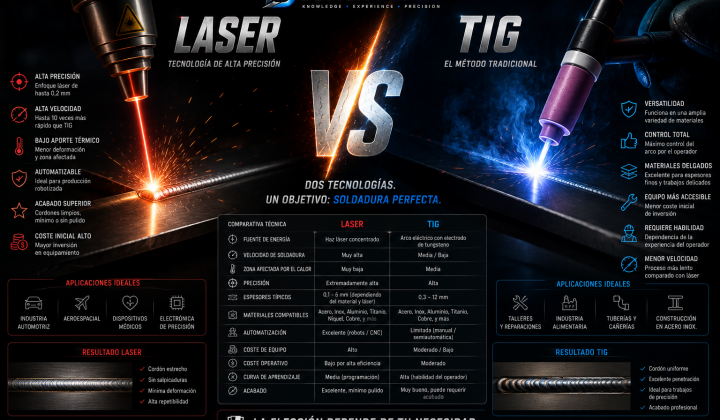
Comparison between laser and TIG welding focusing on the advantages of laser: speed, distortion, penetration, and automation.