No Catergory 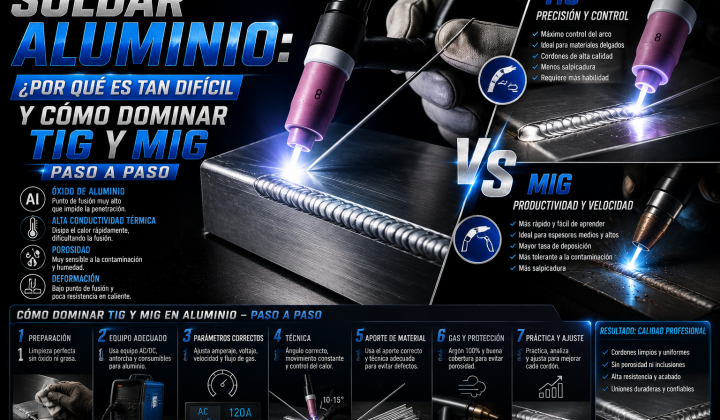
Welding Aluminum: Why It’s So Difficult and How to Master TIG and MIG Step by Step
Beginner's Guide to Aluminum Welding: Oxide Cleaning, Shielding Gas, Polarity, and Equipment Settings for TIG and MIG.

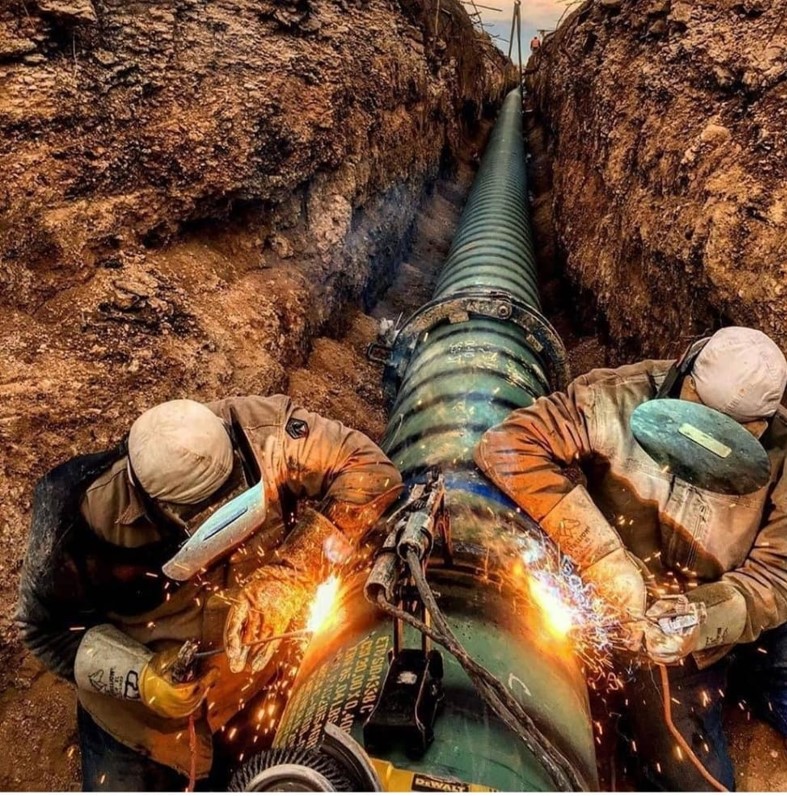
At Doctor Welding we continue discussing the history of welding, and it is now the turn of shielded metal arc welding electrodes. It is worth noting that the first step toward the invention and development of welding was taken by Sir Humphry Davy in 1801, considered by many as the founder of electrochemistry. When he discovered that it was possible to conduct electricity through air between two electrodes, the electric arc was thus discovered. The first electrodes used were bare rods with no coating whatsoever, which produced unstable arcs, irregular beads, excessive spatter, and a high degree of brittleness in the weld metal due to contamination of the weld pool. As welding continued to develop, coatings made from various organic and inorganic materials began to be used; although at first this was done simply to stabilize the arc rather than to produce clean welds.
As highlighted in the previous article, it was in 1885 that the Russian N. Bernardos established the possibility of generating a molten pool between two electrodes (a carbon cathode and a metal anode) to join metal workpieces, and in doing so patented the first welding equipment in England.
Later, Slavianoff became the first to create a consumable (metal) electrode in 1892. The Swedish inventor Oscar Kjellberg was the first to patent a coated electrode in 1907, and also founded the company ESAB.
In the United States in 1912, Strohmenger and Slaughter patented the first heavily coated electrode, which began to be used at an industrial level. Its adoption was quite slow due to its high cost. From the early 1920s, research into gas shielding for welding operations began, but the development and widespread adoption of the SMAW process led to a loss of interest in gas-shielded processes.
Between 1930 and 1935, SMAW operations reached the heavy infrastructure sector; it was during those years that the first all-welded ships were built in both the United States and Germany. Simultaneously, in 1932, experiments with continuous electrodes protected by granular flux began, and from 1935 onward the SAW (Submerged Arc Welding) process became established in shipbuilding and pipe manufacturing. It was also in that year (1935) that the use of Alternating Current was introduced, which, despite its advantages, presented arc stability challenges — challenges that drove the development of improved coatings for SMAW covered electrodes.
The first gas-shielded process was called HELIARC, named after helium, the first shielding gas used. This process, known as GTAW (Gas Tungsten Arc Welding), was initially used with DC, then optimized for use with AC, and subsequently enhanced by the implementation of high-frequency units, which achieved greater arc stability as well as the ability to weld metals with high thermal conductivity and reduced thicknesses. By the early 1940s, the use of argon as a shielding gas had become established. Between 1938 and 1940, it was discovered that, due to the high temperatures at the arc core, the coating elements (flux), upon atomic decomposition, produced CO₂, which proved to be a gas with excellent properties as an arc shielding agent.
The GTAW process became established for welding highly reactive metals of limited thickness; however, a significant gap still existed with regard to high-productivity processes. Consequently, in 1948 the GMAW (Gas Metal Arc Welding) process was developed, building on the previous process by replacing the tungsten with a continuous wire electrode. The process initially used inert gases (He, Ar) and subsequently active gases (CO₂), both of which continue to be used to this day. In pursuit of a high-productivity process simpler than GMAW, trials were conducted with long coated electrodes; however, when coiled, these caused the coating to crack and break away. After extensive research, the FCAW process was launched in 1957, initially used with shielding gas and later without.
Today there is a wide variety of electrodes available for different applications, including both fabrication and repair work, hardfacing, and use with or without shielding gas. Technological advances have led to the optimization and derivation of existing processes rather than the creation of entirely new ones — examples include laser welding, electroslag welding, plasma welding, and even the complete fabrication of components by welding alone, with no machining whatsoever.
There is no doubt that FCAW and GMAW are the most significant productive processes currently in use; they are employed in the construction of pipeline systems, structures, and storage tanks, as well as in the fabrication of industrial metal components.
Ask the DoctorWelding assistant about this topic and it answers citing our articles.

Beginner's Guide to Aluminum Welding: Oxide Cleaning, Shielding Gas, Polarity, and Equipment Settings for TIG and MIG.
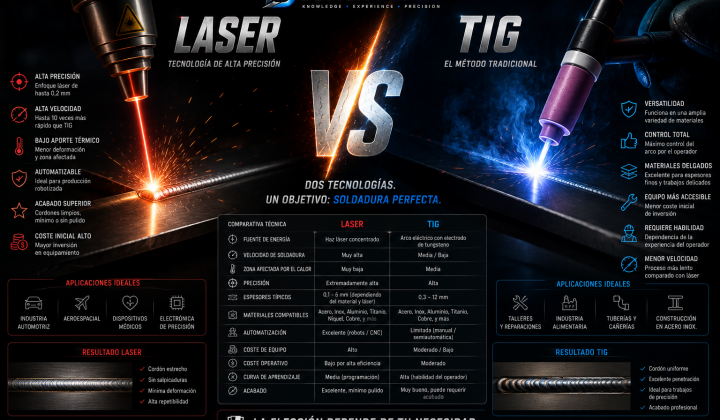
Comparison between laser and TIG welding focusing on the advantages of laser: speed, distortion, penetration, and automation.