No Catergory 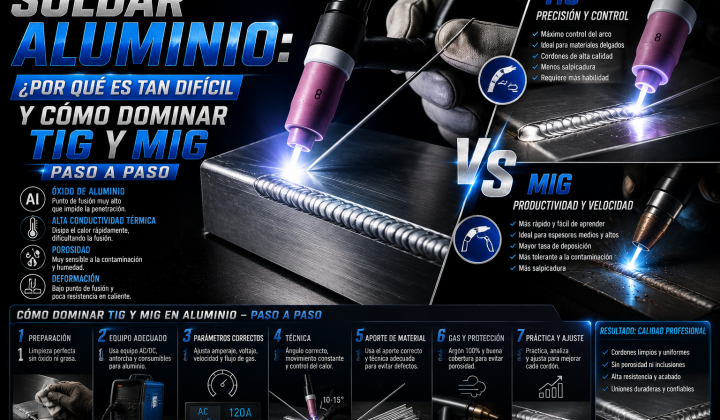
Welding Aluminum: Why It’s So Difficult and How to Master TIG and MIG Step by Step
Beginner's Guide to Aluminum Welding: Oxide Cleaning, Shielding Gas, Polarity, and Equipment Settings for TIG and MIG.
Both oxygen in the form of oxides and hydrogen can originate from the surface of the filler metal or base metal.
Hydrogen can originate from:
• Moisture, for example, condensation on surfaces.
• Moisture in mill scale, oxides, or rust.
• Hydrocarbon contamination from grease or oil.
Oxides originate from mill scale and other sources. Shielding gases are virtually never contaminated in the cylinder or tank, but they can become contaminated during the welding process itself. One of the causes is the entry of air and moisture into the shielding gas system through:
• Defective hoses.
• Leaking connections.
• Diffusion through hoses.
• Leaks in water-cooled torches.
• Moisture buildup in hoses during extended periods without welding.
Filler metal contamination can cause porosity, embrittlement, and reduced corrosion resistance. Both porosity and embrittlement lead to weld weakening. Porosity can be detected by X-ray inspection, the standard method for testing welds. To
determine whether a tendency toward cracking has developed or whether corrosion properties have deteriorated, other more complex testing methods are required. These tests are generally not performed in connection with welding.
Porosity
The process of porosity formation during gas-shielded arc welding is referred to as metallurgical pore formation. This formation is caused by the fact that the base metal can dissolve different amounts of contaminants at different temperatures. At temperatures high enough to melt the metal, considerable amounts of contaminants can be dissolved. Once the metal solidifies, the solubility of the contaminants decreases drastically.
If impurities are present while the weld is in progress, a certain amount will dissolve into the weld bead. As the metal solidifies, the impurities do not have sufficient time to diffuse out of the material. If the contamination level in the solidifying weld metal exceeds what can be dissolved, gas bubbles will form. Some of the gas bubbles
may rise to the surface and escape, while others remain in the solidifying weld metal, forming pores.
Embrittlement.
An impurity level lower than that required to cause porosity can lead to embrittlement of the welded assembly. In other words, welds may suffer the effects of embrittlement even though X-ray testing shows them to be free of porosity. In steel welding, it is primarily hydrogen that causes embrittlement; this phenomenon is known as hydrogen embrittlement. Relatively high amounts of hydrogen can dissolve into the weld bead; when the metal solidifies, hydrogen that has been unable to diffuse out of the material will remain supersaturated in the weld (or will have formed pores).
Through forced dissolution, the microstructure of the steel is altered and the material becomes brittle. As cooling continues, hydrogen atoms diffuse into minute cavities, microcracks, or slag inclusions in the weld metal. There, hydrogen reverts to its gaseous state (2H → H2 gas). The pressure within these cavities can rise to extreme levels.
Around the cavities, the hydrogen concentration is exceptionally high, causing severe embrittlement at that location. The high gas pressure within the cavities and the embrittlement can lead to fracture in welded structures. Nitrogen in certain quantities can also cause embrittlement of steel. However, nitrogen does not tend to concentrate around cracks and cavities in the same manner as hydrogen, which reduces the risk of nitrogen embrittlement. Embrittlement can also occur in other materials; for example, titanium can become embrittled by the effect of nitrogen and oxygen, as this occurs because nitrogen and oxygen atoms dissolved in the metals cause dislocations in the matrix. Hydrogen can also cause embrittlement in titanium. Hydrogen dissolved in the weld metal precipitates during cooling in the form of hydrides, which reduce the impact toughness of the material, making it more brittle.
Ask the DoctorWelding assistant about this topic and it answers citing our articles.

Beginner's Guide to Aluminum Welding: Oxide Cleaning, Shielding Gas, Polarity, and Equipment Settings for TIG and MIG.
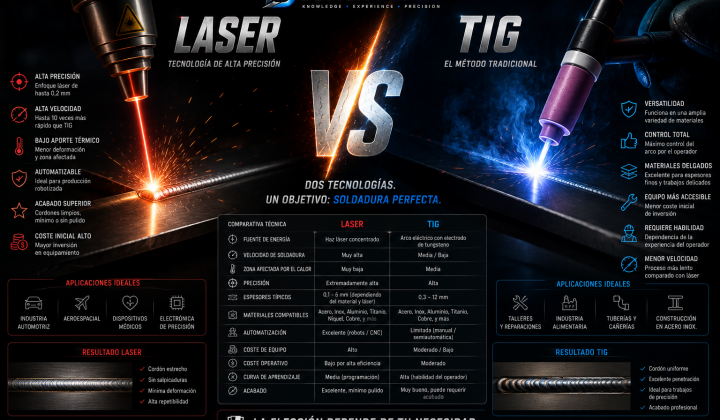
Comparison between laser and TIG welding focusing on the advantages of laser: speed, distortion, penetration, and automation.