No Catergory 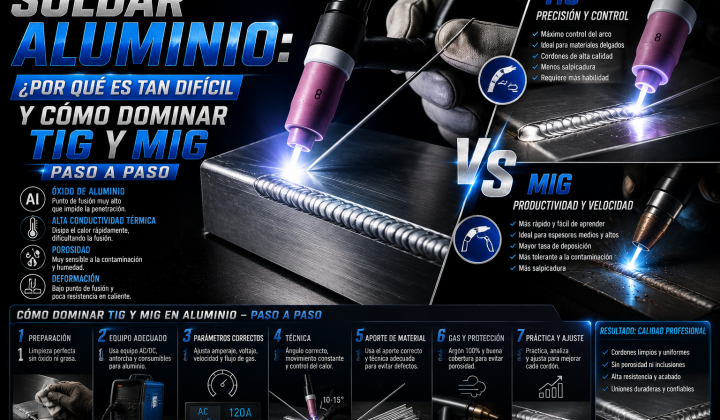
Welding Aluminum: Why It’s So Difficult and How to Master TIG and MIG Step by Step
Beginner's Guide to Aluminum Welding: Oxide Cleaning, Shielding Gas, Polarity, and Equipment Settings for TIG and MIG.

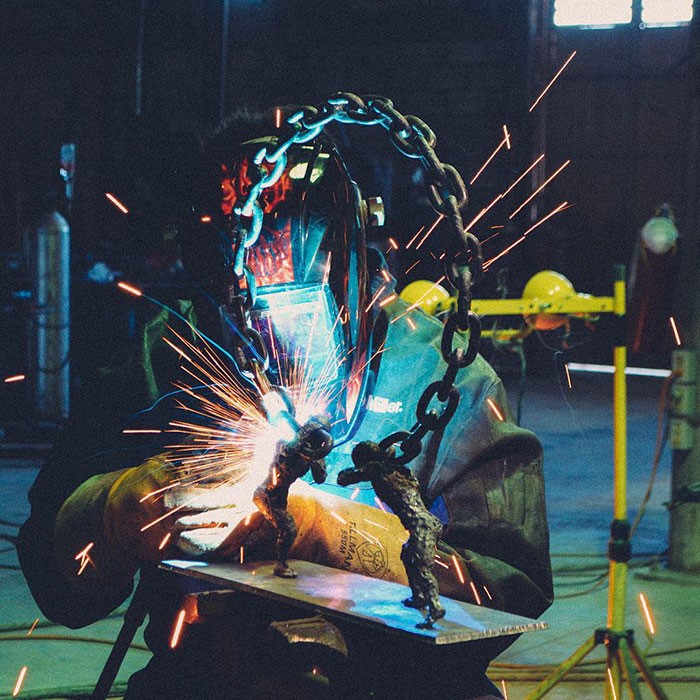
The first welding helmets were made of pressed cardboard; these were hand-held shields used in the 1930s. The shape of the helmet was conditioned or limited by the manufacturing processes of the time and the materials and production technologies available.
In the 1960s, welding helmets already allowed workers to use both hands, but as technology advanced with an increasing focus on protection and safety, a helmet-style design emerged that tends to provide greater protection to the entire perimeter of the head and neck.
With the evolution and modernization of industrial processes experienced in recent years, worker protection has become increasingly important, and one of the key elements to consider in this regard is the welding helmet, since the hazardous ultraviolet and infrared rays emitted during welding have caused many occupational diseases among welders throughout history.
In mid-1981, Swedish manufacturer Hornell International introduced an electronic LCD shutter that automatically darkens when its sensors detect the brightness of the welding arc. These helmets were marketed as the Speedglas Auto-Darkening Filter.45. This type of helmet features auto-darkening electronic technology, where the welder no longer needs to position himself looking at the weld point, lower the helmet over his face, and then strike the arc. The advantage is that the welder does not need to manually adjust the position of the helmet, which not only saves time but also reduces the risk of exposure to the harmful light generated by the welding process.
It was in January 2004 that multinational corporation 3M acquired all of Hornell’s assets, including the brand and patents for the Adflo powered air-purifying respirator (PAPR) and Speedglas welding helmets. Speedglas helmets then began to be sold under the 3M brand. Today, several brands feature the same technology and have improved welder performance, since welding processes tend to be among the highest-risk occupations due to the many factors that can affect a welder’s health, including high levels of spatter, fumes, ultraviolet rays, and infrared rays emitted by the welding arc. For these reasons, it is essential to implement strict safety measures to maximize the physical protection of operators.
Welding helmets and shields come in a variety of designs, including models combined with hard hats for use on construction sites and versions with adaptations to protect the eyes during slag removal. Hand-held welding shields are suitable for fit-up and tack welding operations; however, their use is not recommended when working at heights or when the operator needs both hands free. The shade lens, whose purpose is to protect the eyes from UV and infrared radiation, must be selected according to the amperage used. Good visibility must be maintained by replacing the protective cover lens when there is excessive spatter buildup. Technology advances every day, but protection always remains the top priority.
Ask the DoctorWelding assistant about this topic and it answers citing our articles.

Beginner's Guide to Aluminum Welding: Oxide Cleaning, Shielding Gas, Polarity, and Equipment Settings for TIG and MIG.
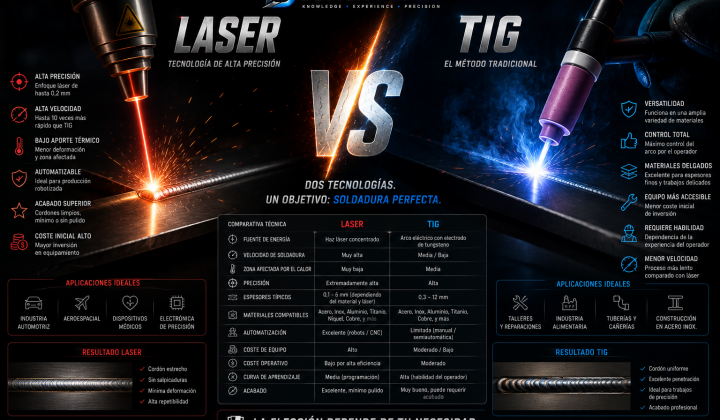
Comparison between laser and TIG welding focusing on the advantages of laser: speed, distortion, penetration, and automation.