No Catergory 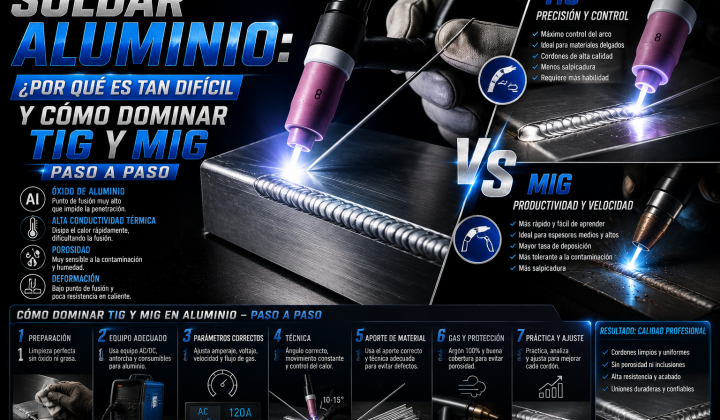
Welding Aluminum: Why It’s So Difficult and How to Master TIG and MIG Step by Step
Beginner's Guide to Aluminum Welding: Oxide Cleaning, Shielding Gas, Polarity, and Equipment Settings for TIG and MIG.
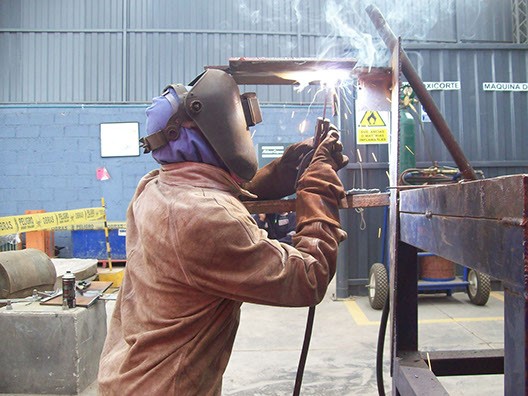
In welding work, years of experience alone are not sufficient; the work performed on a daily basis requires documentation that certifies the welder’s skill and the type of work they carry out.
Undoubtedly, experience plays an important role in this type of work, but skill must be verified in accordance with standard codes or fabrication standards.
A welder’s qualification is valid indefinitely, provided the welder does not have a work lapse of 6 months — a period that determines that skill may be affected and result in welds with quality issues. Codes, standards, or specifications establish the characteristics and criteria for qualifying a welder. It should be emphasized that if a welder is qualified under the criteria of API Standard 1104, they are not qualified to perform structural welding, regardless of their skill level; the criteria and requirements of the codes are very different.
It should be clarified that the fact that a welder presents their qualification does not guarantee that they are approved to perform any type of welding work; the qualification is granted according to the applicable code or fabrication standard.
The American Petroleum Institute (API), through its Standard 1104, establishes the criteria for joining carbon steel and low-alloy steel pipelines used in hydrocarbon transportation. The American Society of Mechanical Engineers (ASME) establishes the criteria for the fabrication of pressure vessels, such as tanks, boilers, etc., and the American Welding Society (AWS) establishes codes and criteria for the fabrication of metal structures. These are the principal organizations, but there are additional entities that establish criteria and standards with the purpose of implementing quality controls and preventing accidents.
A welder or welding operator may be qualified by radiographic testing of a test assembly, radiographic testing of the initial production weld joint, or by bend tests taken from a test assembly in accordance with the applicable welding code or standard.
Welders or welding operators employed to produce such welded joints shall be qualified under the complete supervision and control of the manufacturer, contractor, assembler, or installer during the production of these test assemblies. It is not permissible for the manufacturer, contractor, assembler, or installer to have the welding performed by another organization. However, it is permissible to subcontract some or all of the work involved in the preparation of test materials for welding, the subsequent work in the preparation of test specimens to be obtained from the completed assemblies, and the performance of nondestructive examination and mechanical testing, provided that the manufacturer, contractor, assembler, or installer accepts full responsibility for any such work.
Each organizational representative shall complete and sign a Welder/Welding Operator Performance Qualification Record (WPQ) for each welder or welding machine operator.
Contents of a WPQ
The Welder/Welding Operator Performance Qualification Record (WPQ) shall include the essential variables, the type of test, and the test results, as well as the qualified ranges for each welder and welding operator. A suggested format for these records should highlight all relevant information specified by the applicable standard for each job.
For this document to have legal validity, it must be signed by a certified Inspector and endorsed by any entity accredited by the local or international governing authority.
Ask the DoctorWelding assistant about this topic and it answers citing our articles.

Beginner's Guide to Aluminum Welding: Oxide Cleaning, Shielding Gas, Polarity, and Equipment Settings for TIG and MIG.
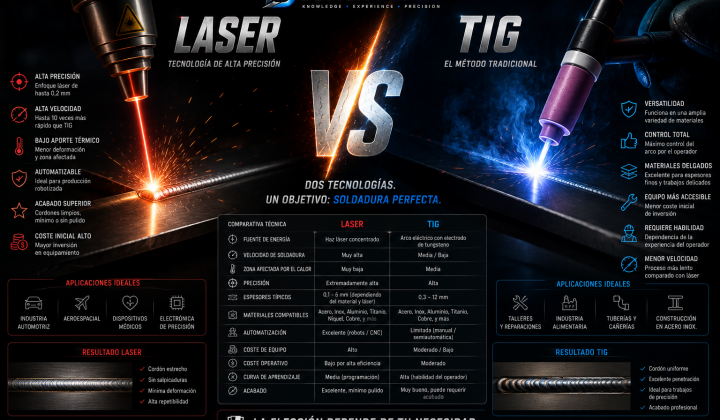
Comparison between laser and TIG welding focusing on the advantages of laser: speed, distortion, penetration, and automation.