No Catergory 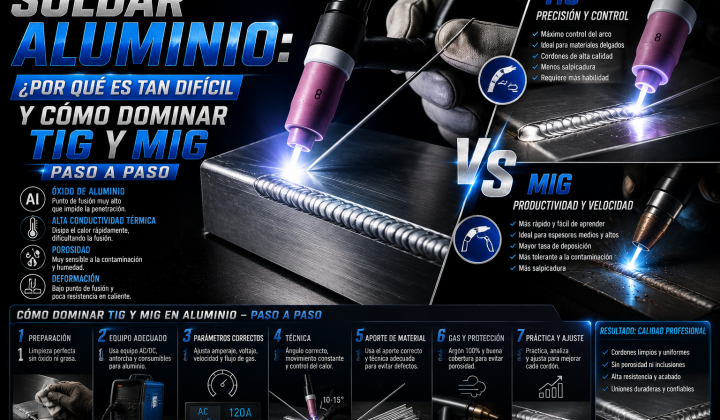
Welding Aluminum: Why It’s So Difficult and How to Master TIG and MIG Step by Step
Beginner's Guide to Aluminum Welding: Oxide Cleaning, Shielding Gas, Polarity, and Equipment Settings for TIG and MIG.
The first thing to do is identify the base material to be welded and which tungsten electrode options can be used for the welding application.
Remember that not all electrodes are suitable for all materials to be welded, as arc starting and arc stability can be affected.
Below are the most common tungsten types and their corresponding base materials.
(GREEN TIP) WP – PURE TUNGSTEN
It is the most widely used for welding with alternating current AC. It is used primarily for welding aluminum and magnesium.
(GRAY TIP) WC20 – 2% CERIATED
It is suitable for welding applications with both alternating current and direct current DC AC, with excellent arc starting capability at low amperages. It is used for pipe welding and tank fabrication. It also performs excellently for welding small or delicate workpieces. It is not recommended for high-amperage applications.
(BLUE TIP) WL20 – 2% LANTHANATED
An excellent lanthanated tungsten electrode alternative. Also known as the stainless steel tungsten electrode. It is highly versatile for AC / DC and is recommended for carbon steel, stainless steel, nickel alloys, titanium, and aluminum.
(RED TIP) WT20 – 2% THORIATED
This material is prohibited in many countries due to radiation emissions. This electrode offers excellent arc ignition even at low amperage and is widely used with DC for steel, stainless steel, nickel alloys, titanium, and copper. It is not recommended for use with alternating current AC for welding aluminum.
(PURPLE TIP) RARE EARTH
It produces a very stable arc and low heat at the tip, resulting in less wear and a longer service life than thoriated tungsten electrodes. It is excellent for welder productivity and safety. Additionally, it provides superior arc starting and performs excellently with both direct and alternating current, making it ideal for welding titanium, magnesium alloys, aluminum, copper, brass, carbon steels, and stainless steels.
Ask the DoctorWelding assistant about this topic and it answers citing our articles.

Beginner's Guide to Aluminum Welding: Oxide Cleaning, Shielding Gas, Polarity, and Equipment Settings for TIG and MIG.
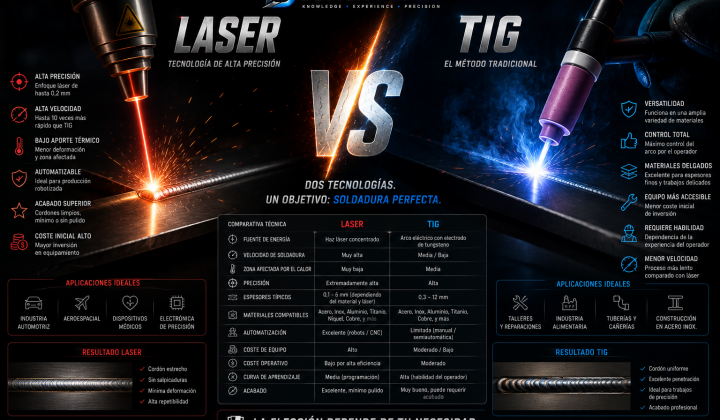
Comparison between laser and TIG welding focusing on the advantages of laser: speed, distortion, penetration, and automation.